
I’ll be honest with you. After spending more than a decade studying habits, success, and human behavior, I’ve watched thousands of people chase massive transformations — only to crash and burn within weeks. And I’ve watched a quiet few, who did almost nothing impressive on any given day, build extraordinary lives.
The difference? They understood one principle that most people dismiss as too simple to matter. It’s called the 1% Rule, and once you truly grasp it, you’ll never think about success the same way again.
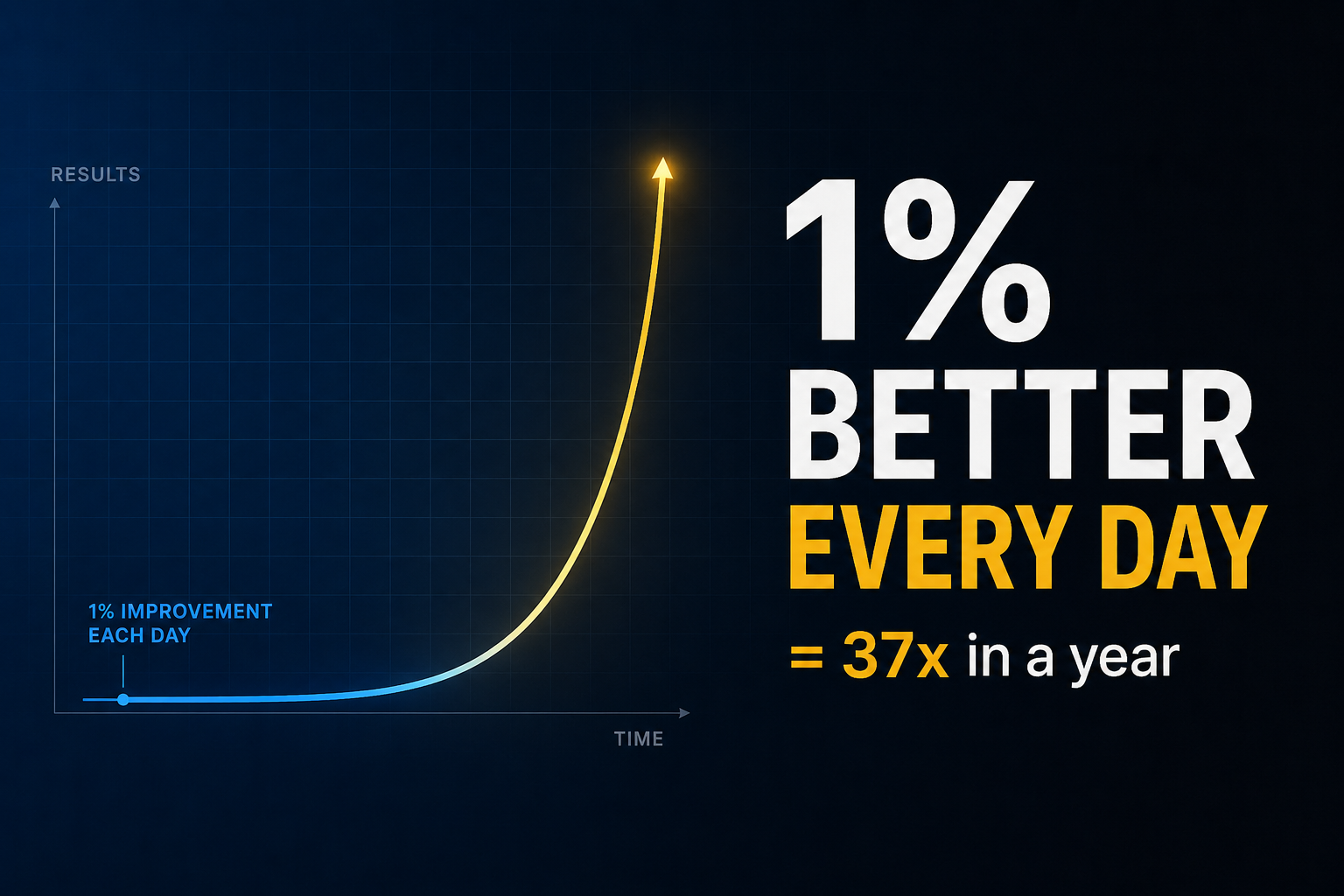
The idea sounds almost laughable at first: if you improve by just 1% every single day, you’ll end up 37 times better by the end of the year. Not 37% better — 37 times better. That’s not motivational fluff. That’s compound mathematics, the same force that turns small savings into generational wealth.
And the reverse? Equally brutal. Get 1% worse every day, and within a year, you decline to almost nothing.
In this article, I’m going to break down everything I’ve learned about the 1% Rule over the years — the science behind why it works, why most people fail at it, and how to actually apply it in your real life starting today.
What Is the 1% Rule, Really?
The 1% Rule was popularized by James Clear in his bestselling book Atomic Habits, but the principle has existed for centuries in different forms. The Japanese call it kaizen. Athletes call it marginal gains. Investors call it compounding.
At its core, the rule states that small, consistent improvements stack up over time to produce massive, often unbelievable, results.
Here’s the math that should change your life:
- 1.01 raised to the power of 365 = 37.78
- 0.99 raised to the power of 365 = 0.03
Read those numbers again. The gap between being 1% better and 1% worse every day isn’t small. It’s the difference between becoming a different person entirely and becoming nothing at all.
What I love about this principle is how it dismantles the biggest lie of self-improvement culture — that transformation requires dramatic action. It doesn’t. It requires consistent, almost invisible action, repeated over enough time.
The Science Behind Why It Works
In all my years studying this stuff, I’ve found four reasons why the 1% Rule works so reliably — while almost every other self-improvement strategy fails.
1. Small Actions Don’t Trigger Resistance
Your brain has a built-in resistance system. The moment you try to do something hard, it fights back. This is why “I’ll work out 2 hours every day starting Monday” never works — your brain treats it as a threat.
But 5 pushups? Your brain doesn’t even register it as effort. There’s nothing to resist. And once you start, you usually do more anyway.
2. Habits Build Their Own Neural Pathways
Every time you repeat a behavior, you strengthen the neural pathway responsible for it. After a few weeks, what felt like effort becomes automatic. This is why people who read daily eventually feel wrong when they skip a day — their brain has literally rewired itself.
3. Identity Shifts Beat Goal-Chasing
Here’s something most people miss: the real power of small habits isn’t what you achieve — it’s who you become.
Every small action is a vote for the type of person you want to be. Write 100 words a day, and over time you don’t just have a manuscript — you become a writer. Read 10 pages a day, and you become a reader, a thinker, someone who knows things.
Goals are temporary. Identity is permanent.
4. Time Does the Heavy Lifting
The hidden magic of compounding is that it only reveals itself with patience. In month one, 1% gains look like nothing. By month six, the difference becomes visible. By year one, it’s dramatic. By year five, you’re in a completely different reality than the person who never started.
Most people quit before the magic kicks in. That’s the only reason they fail.
Why Most People Fail at the 1% Rule
If the math is so clear and the strategy so simple, why does almost everyone still fail? After watching thousands of people try, I’ve identified three killers.
The Plateau of Latent Potential
When you start a new habit, you expect linear progress: do the work, see results. But that’s not reality. Results always lag behind effort — sometimes by months.
Think of an ice cube slowly warming from 25°F to 31°F. Nothing visible happens. Then at 32°F, it melts. The transformation was building all along — you just couldn’t see it.
This invisible gap is where 99% of people quit. They do the work for 30 days, see no results, and conclude it doesn’t work. Meanwhile, they were one week away from breakthrough.
The Dopamine Trap
Modern life has trained your brain to crave instant rewards. Social media gives you a hit in seconds. Food delivery in minutes. Entertainment on demand. So when daily improvements don’t pay off instantly, your brain interprets it as failure and abandons ship.
The 1% Rule asks you to do something almost alien in 2025 — trust delayed compounding.
The “All or Nothing” Mindset
This one kills more people than anything else. They think small actions are pointless. “What’s the point of reading 2 pages? I should read 50.”
So they try to read 50, fail by day three, feel terrible about themselves, and quit altogether. Meanwhile, the unglamorous reader doing 2 pages a day finishes 10 books in a year — effortlessly.
The 1% Rule isn’t about doing more. It’s about doing something consistently, especially on the days you don’t feel like it.
How to Apply the 1% Rule Starting Today
Enough theory. Here’s the exact framework I’ve seen work over and over again — no motivation or willpower required.
Step 1: Pick Just One Area
The single biggest mistake I see is people trying to improve everything at once — fitness, reading, meditation, finances, relationships — all in the same week. This guarantees failure.
Pick one area that matters most right now. Just one. Everything else can wait.
Step 2: Define Your Ridiculously Small Action
Ask yourself: “What’s the smallest possible version of this habit?”
- Want to get fit? 5 pushups a day.
- Want to read more? 2 pages before bed.
- Want to write a book? 100 words a day.
- Want to learn a skill? 10 minutes of practice.
- Want to save money? 50 rupees a day.
The action should feel almost embarrassingly small. That’s the point. Small enough that you’ll do it even on your worst day.
Step 3: Anchor It to an Existing Habit
This is called habit stacking, and it’s one of the most powerful tricks I’ve ever learned. Attach your new habit to something you already do automatically.
- After I brush my teeth → I do 5 pushups.
- After I make my morning coffee → I read 2 pages.
- After I close my laptop at night → I write 100 words.
You’re using existing neural pathways instead of building new ones from scratch. The habit practically does itself.
Step 4: Track It Visibly
You can’t improve what you don’t measure. Use a simple habit tracker — a notebook, an app, or just a calendar where you mark an X every day you complete the action.
The chain of X’s becomes motivation in itself. After 10 days, you won’t want to break the streak.
Step 5: Never Miss Twice
This single rule separates the people who win from the people who quit:
You’re allowed to miss one day. You’re never allowed to miss two in a row.
Missing once is an accident. Missing twice is the start of a new habit — the habit of not doing.
You will slip up. Everyone does. The winners just bounce back immediately, while everyone else uses one missed day as an excuse to quit forever.
Real Examples of the 1% Rule in Action
Theory is fine, but proof is better. Let me share two stories that show this principle in action.
The British Cycling Team’s Transformation
For nearly 100 years, British cycling was painfully mediocre. Then in 2003, performance director Dave Brailsford introduced what he called “the aggregation of marginal gains” — improving every aspect of cycling by just 1%.
They redesigned bike seats for comfort. Tested different massage gels. Brought their own pillows on tours for better sleep. Even repainted the team truck white so they could spot dust on the bikes.
None of these changes seemed significant individually. But stacked together? Within five years, British cyclists dominated the Olympics and Tour de France. Tiny gains, applied consistently, created world-class performance.
Warren Buffett’s Reading Habit
Warren Buffett, one of the wealthiest people who has ever lived, attributes his success to one habit: reading 500 pages a day. But he didn’t start that way. He started small — just a few pages — and built up over decades.
When asked the secret to success, he once said something that stuck with me forever:
“Read 500 pages every day. That’s how knowledge works. It builds up, like compound interest.”
His wealth isn’t an accident. It’s the byproduct of compound learning over 70+ years.
The Hidden Lesson of the 1% Rule
Here’s what most articles about self-improvement won’t tell you, and what I want you to take away from this one:
The 1% Rule isn’t really about success. It’s about who you become while pursuing it.
Goals don’t shape you. Habits do. And tiny habits, repeated daily, compound into the person you’ll be in five years.
I’ve seen people transform their entire lives this way — not through one heroic effort, but through thousands of unremarkable days where they just showed up and did the small thing.
You’ve actually already experienced the 1% Rule — in reverse. Small bad habits stacked up over years: scrolling 10 extra minutes, eating one extra junk meal, sleeping 30 minutes late. None felt significant at the time. But together, they shaped who you are right now.
The good news? You can reverse the equation. Starting today.
The math doesn’t lie. The only real question is: are you patient enough to let it work?
Start small. Start today. Trust the compound.
Because one year from now, you’ll either be 37 times better — or you’ll wish you had started today.
What’s the one 1% habit you’re going to start with? Drop it in the comments — sometimes just writing it down publicly is the first vote for the new you.
1 thought on “The 1% Rule: How Small Daily Improvements Compound Into Massive Success”