
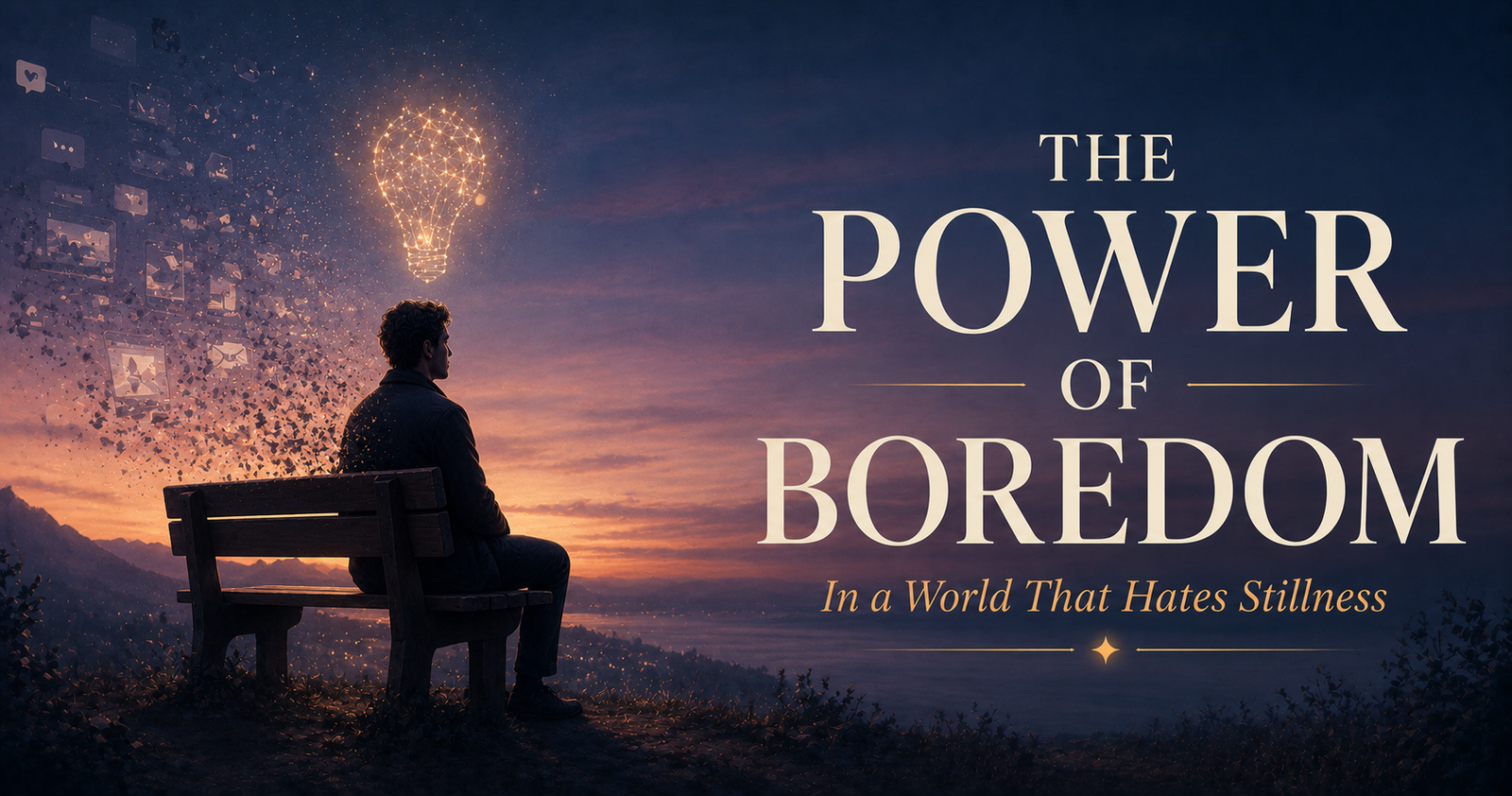
The last time you were truly bored — when did it happen? Not “had nothing to do” bored. Genuinely bored. No phone in hand. No music. No podcast. No background noise. Just you, sitting with the slow weight of an unstimulated moment, with nothing to escape into.
For most people alive today, the honest answer is years ago. Maybe never, in adulthood. We’ve engineered boredom out of human existence almost entirely. The instant a moment threatens to become empty, we fill it — with scrolling, with content, with anything except the silence we used to find so ordinary.
After more than a decade studying psychology, creativity, and what makes minds work well, I’ve come to a conclusion that contradicts everything modern life teaches. The disappearance of boredom is one of the greatest hidden tragedies of our time. Boredom isn’t the enemy of a meaningful life. It’s the doorway to one. And the people who’ve eliminated it from their existence have, without realizing it, eliminated something essential about being human.
In this article, I’ll walk you through the surprising science behind the power of boredom, why your brain genuinely needs it to function, and how to reintroduce boredom into a life that’s been engineered to never feel still.
Why We’re So Terrified of Boredom
Modern people treat boredom like a problem to be solved, not a state to be experienced. The moment we feel it approaching — at a traffic signal, in a waiting room, walking from one place to another — our hand reaches for the phone before we’ve consciously decided to.
This isn’t a personal failing. It’s a learned reflex. Decades of constant stimulation have trained our brains to associate even brief stillness with discomfort. Boredom feels like an alarm — fix this immediately. So we do. We fill every gap. We consume during every interstitial second. And we never realize what we’re losing in the process.
Research from the American Psychological Association consistently shows that the modern aversion to stillness correlates with rising anxiety, shrinking creativity, and a measurable decline in the kind of deep thinking that produces genuine insight. We didn’t escape boredom. We just replaced it with something far worse — perpetual mild stimulation that never satisfies and never lets the mind rest.
What Boredom Actually Does for Your Brain
Here’s what almost no one knows about boredom. When your brain has nothing external to react to, it doesn’t go offline. It does the opposite. It enters what neuroscientists call the default mode network — a powerful background process that handles some of the most important work your mind ever does.
In this state, your brain consolidates memories, processes emotions, makes unexpected connections between ideas, and generates the kind of insight that simply can’t appear when you’re consuming content. The “aha!” moments of history almost always came during boredom — walks, baths, sleepless nights, idle commutes. Never during scrolling.
Studies referenced on Harvard Health confirm what poets and philosophers always suspected — the mind needs unstructured stillness to do its deepest work. By eliminating boredom, modern life has also eliminated the conditions that produce genuine creativity, self-awareness, and emotional integration.
The Hidden Cost of a Life Without Stillness
If you can’t remember the last time you were genuinely bored, here’s what you may have quietly lost:
- The ability to generate ideas — not consume them, but actually have them
- The capacity for deep emotional processing
- Real self-awareness, which only emerges in silence
- Patience and tolerance for slow, meaningful activities
- The kind of attention required for long-form work and deep reading
- A sense of inner solidity that doesn’t depend on external input
The damage isn’t dramatic. It’s a slow shrinking of inner life. You become someone who can consume infinite content but cannot sit alone with your own thoughts. You become someone who reacts to everything but produces almost nothing original. You become someone whose sense of self requires constant external validation because the inner self has been quietly starved of attention.
Why Creativity Lives Inside Boredom
Here’s something that contradicts every productivity guru’s advice. Almost every great creative insight, scientific breakthrough, and original idea in human history was born during boredom — not during work, not during focused study, but during the empty moments that came after.
Einstein worked at a quiet patent office partly because it gave him stretches of mental stillness to develop relativity. Newton produced some of his greatest insights during the plague years when he had nothing to do but think. Countless writers describe their best ideas arriving during walks, showers, or moments of staring into space. The pattern repeats across centuries and cultures.
The reason is simple. Creativity requires the mind to wander — to make connections between distant ideas that focused effort can’t see. When you fill every moment with stimulation, you eliminate the conditions that produce these connections. You can be productive without boredom. You cannot be deeply creative. Those are different things, and modern life has confused them.
The Difference Between Productive Boredom and Discomfort
Not all boredom is the same. There’s a difference between productive boredom — the kind that enables creativity and self-discovery — and restless discomfort that just feels like wasting time.
Productive boredom is intentional. You’re sitting, walking, or quietly doing nothing — but you’re present in it. You’re not anxiously waiting for it to end. You’re letting your mind drift, observing what comes up without judgment.
Restless discomfort is reactive. You’re bored, but every cell of your body is screaming for distraction. You feel anxious, agitated, unable to settle. This is what most people feel the moment they sit without their phone — and they mistake it for boredom being bad. It isn’t bad. It’s just unfamiliar.
If you push through the initial discomfort, something remarkable happens. The restless boredom transforms into productive boredom. Your mind settles. Ideas emerge. Emotional clarity arrives. The thing you were running from turns out to be the thing your mind was starving for. This connects deeply to why you can’t focus anymore — both problems share the same root cause.
How to Reintroduce Boredom Into Modern Life
Reclaiming boredom isn’t about doing less. It’s about creating intentional gaps that let your mind rest, wander, and integrate. Here’s how to start.
1. Walk Without Your Phone
Start with one walk a day — even just 10 minutes — completely phone-free. No music, no podcasts, no notifications. Just you and the world around you. This single habit reintroduces more boredom than almost anything else you can do.
The first few walks will feel boring (good — that’s the point). Within a week, ideas, memories, and emotional insights start appearing seemingly out of nowhere. They were always there. They just couldn’t reach you while a podcast was playing.
2. Reclaim Transitional Moments
The moments between activities — standing in line, waiting for an elevator, sitting at a red light, brushing your teeth — these used to be natural pockets of boredom. Now they’re filled with phone-checking by reflex.
Practice not reaching for your phone in transitional moments. Just be there. Notice the room. Watch your thoughts. Let your mind drift. These tiny moments add up to dozens of restorative pauses every day that most people have eliminated entirely.
3. Schedule “Nothing Time”
Once a week, give yourself an hour with no plan, no input, and no purpose. Don’t read. Don’t scroll. Don’t even meditate formally. Just sit somewhere — a chair, a park bench, the floor of your room — and let time pass without filling it.
This sounds unproductive. It’s actually some of the most powerful brain work you’ll ever do. After a few sessions, you’ll notice that the rest of your week starts feeling different — clearer, calmer, more creative.
4. Create One Phone-Free Hour Daily
Pick a one-hour window where your phone goes in another room. Morning is best for most people — before the world starts pulling at you. Use this hour for slow activities — reading a book, cooking, writing by hand, sitting with coffee, watching the sky.
This hour will feel boring at first. Don’t escape it. The boredom is where your mind comes back to itself.
5. Embrace Slow Activities
Cooking from scratch. Walking instead of driving for short distances. Reading physical books instead of phones. Writing in a notebook. Having long, unrushed conversations. These activities feel boring in a world of speed, but they’re where the deepest living happens.
Modern life optimizes for efficiency. Meaning often lives in inefficiency — in the slow moments that have no immediate payoff but quietly nourish the soul. This is also why finding your purpose often requires more boredom than busyness.
6. Stop Outsourcing Your Mind
Every time you immediately Google a question instead of thinking about it, every time you watch a video instead of pondering, every time you ask AI instead of reflecting — you outsource your mind. Boredom is where your mind gets to actually work. Reclaim some of that work. Let questions sit unanswered. Let problems marinate. Trust your brain enough to give it space to actually think.
The Deepest Truth About the Power of Boredom
Here’s what nobody told us when we collectively decided to eliminate boredom from human experience. The capacity to be alone with your own thoughts, without distraction, is the foundation of every meaningful inner life. Strip it away, and you don’t just lose creativity. You lose a relationship with yourself.
The people most lost in the modern world aren’t the ones with bad lives. They’re the ones who can’t be alone with themselves for five minutes without reaching for something to escape into. They’ve fled boredom so successfully that they’ve fled their own minds. And the cost is a quiet emptiness no amount of content can fill.
The good news is that this is reversible. The mind that’s been starved of stillness can be slowly nourished back to richness. It takes time. It feels uncomfortable at first. But within weeks of even small boredom practices, something profound starts to come back. Your inner world expands. Ideas flow more easily. Emotional clarity arrives without being summoned. You start feeling like a person again, not just a node receiving input.
Your First Step Into Reclaimed Stillness
Take one walk this week without your phone. Just one. No podcasts, no music, no notifications, no destination. Walk for at least 15 minutes. Let yourself be bored. Let your mind wander. Don’t try to make anything happen.
You’ll feel restless at first. Notice that. Notice the urge to reach for a phone you don’t have. Notice your mind generating little excuses to end the walk. Stay with it. Within the first walk, something starts shifting. By the third or fourth, you’ll start looking forward to it. By the tenth, you’ll wonder how you ever functioned without these spaces in your week.
The power of boredom isn’t a productivity hack. It’s something older and deeper — a return to a way of being human that the modern world has nearly erased. The version of you who can sit quietly, think clearly, and create freely isn’t gone. They’re just buried under decades of stimulation. The phone-free walk is the first shovel.
What you’ll find underneath isn’t boring at all. It’s the richest, most original, most alive part of yourself — the part that’s been waiting patiently for you to finally stop running from silence and come home to it.
When was the last time you were genuinely bored — and what did you do with that moment? Drop it in the comments — sometimes naming it is the first step to reclaiming it.