
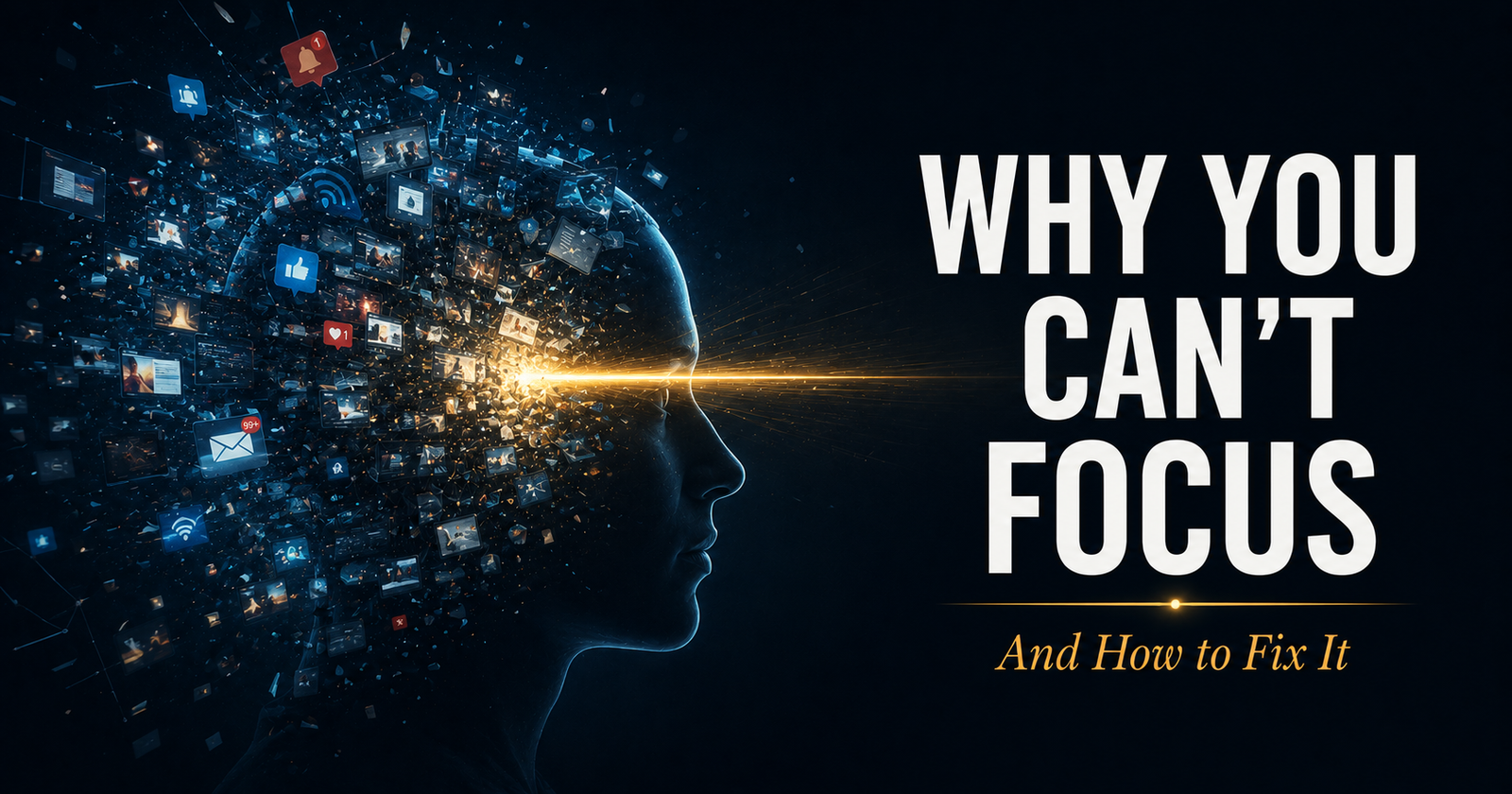
You sit down to do something important. Within two minutes, you check your phone. Within five, you’ve opened a new tab. Within ten, you’ve forgotten what you were trying to do. The book you’ve been “reading” for three weeks remains on page 12. The project you keep meaning to start hasn’t moved. The clarity you remember having years ago feels like it belonged to a different person.
You’re not lazy. You’re not broken. You’re not getting old. You’re experiencing something far more universal and far more disturbing — a collective collapse of human attention that’s happening in real time, to billions of people, including you.
After more than a decade studying behavior, productivity, and the modern mind, I can tell you with full honesty — if you feel like you can’t focus anymore, you’re absolutely right. Your attention has been hijacked by forces specifically engineered to capture and fragment it. And the only way to reclaim it is to understand exactly what’s happening and respond deliberately.
In this article, I’ll walk you through the real reasons you can’t focus, the science of what’s been done to your brain, and 7 proven ways to restore the kind of deep, sustained attention that most modern people will go their entire lives without ever experiencing again.
What’s Actually Happening to Your Attention
Let’s be honest about the scale of this problem. The average human attention span has dropped from around 12 seconds in 2000 to roughly 8 seconds today — shorter than a goldfish’s, according to multiple studies. People now switch tasks every 47 seconds on average. The deep focus required to read a long book, write something meaningful, or solve a hard problem has become genuinely difficult for most adults.
This isn’t normal aging. It isn’t ADHD epidemic. It’s something we’ve never seen before — a generation whose brains have been rewired by technology designed to maximize engagement, not protect attention. Every notification, every infinite scroll, every algorithmically curated feed has trained your brain to expect constant novelty. And brains that expect constant novelty cannot sit still long enough to do anything meaningful.
Research from the American Psychological Association consistently shows that prolonged exposure to fragmented digital content damages working memory, deep reading capacity, and sustained focus. You don’t have a willpower problem. You have a wiring problem. And your wiring was changed without your permission.
Why You Can’t Focus Like You Used To
If you remember being able to focus deeply as a child or teenager and feel like you’ve lost that ability — you have. And it’s not your imagination. Here are the real reasons your focus has collapsed.
Dopamine Hijacking
Every notification, like, and scroll gives your brain a small hit of dopamine — the same neurotransmitter involved in addiction. Over years of micro-rewards, your brain’s reward system gets desensitized. Normal activities — reading, working, conversing — start feeling boring because they don’t produce the same chemical hit. Your brain isn’t broken. It’s just been trained to need stimulation it never used to need.
Constant Context Switching
Every time you check your phone, you’re switching contexts. Research shows that after every interruption, it takes the brain an average of 23 minutes to fully refocus. If you check your phone 80 times a day — a conservative average — your brain literally never enters deep focus. You’re not unable to focus. You’re never given the chance to.
Sleep Deprivation
Most modern adults are chronically under-slept by 1-2 hours every night. Sleep deprivation destroys focus more than almost any other factor. You can do every productivity hack in the world, but if you’re sleeping 6 hours instead of 8, your brain is operating at a fraction of its capacity. This is part of why you might be feeling always tired — and tired brains can’t focus.
Anxiety Background Noise
Modern life produces a constant low-grade anxiety hum — bills, news, comparison, deadlines. Even when you’re not actively worried, your nervous system is mildly activated all day. This eats focus. A calm brain focuses easily. An anxious brain can’t, no matter how hard it tries.
Boredom Intolerance
Most people now reach for their phones the second they feel even a hint of boredom. But boredom is where deep thought lives. By eliminating it, we’ve also eliminated our ability to sit with ideas long enough for them to develop. The hidden power of boredom isn’t just a poetic concept — it’s a neurological necessity that modern life has erased.
The Cost of Living Without Focus
Most people accept their broken focus as just “how things are now.” That acceptance is more expensive than they realize.
- Books read but immediately forgotten
- Conversations had but never absorbed
- Work produced but never deep enough to stand out
- Skills learned superficially but never mastered
- Relationships maintained shallowly because depth requires attention you no longer have
- A creative life that never happens because every spark of inspiration is interrupted before it grows
The damage isn’t dramatic. It’s a slow, invisible erosion of everything that requires sustained attention — which is almost everything that genuinely matters. The shallow life isn’t the result of bad luck. It’s the result of an attention system that can’t go deep enough to build anything real.
7 Ways to Restore Your Focus (Backed by Science)
The good news is that attention is a muscle. It atrophies when unused, but it can be rebuilt. Here are the methods that actually work — supported by research and proven in real lives.
1. Create Physical Distance From Your Phone
This single change will do more for your focus than any productivity app. Put your phone in another room when you’re working. Not on your desk. Not face-down. Not in your pocket. Another room.
Research from Harvard Health confirms that the mere presence of a phone — even if turned off — significantly reduces cognitive capacity. Your brain uses energy resisting it. Remove the option, and the energy returns to your actual work.
2. Use Single-Tasking Blocks of 25-90 Minutes
Multitasking is a myth. Your brain doesn’t multitask — it rapidly switches, and each switch costs energy. Instead, work on one thing only for a defined block of time. Start with 25-minute blocks if you’re rusty (the Pomodoro Technique). Build up to 60-90 minutes for genuinely deep work.
During each block — one tab open, one task, no exceptions. The first few sessions will feel painful. Within two weeks, your focus muscle will start coming back online.
3. Build “Boredom Tolerance” Daily
Each day, sit somewhere quietly for 10 minutes — no phone, no music, no distraction. Just you and your thoughts. It will feel unbearable at first. That’s the point. You’re rebuilding the part of your brain that can sit with discomfort instead of running from it.
This isn’t meditation. It’s something more basic — relearning how to be alone with yourself without external stimulation. It’s the foundation of all deep thinking. Skip this, and no other technique will fully work.
4. Read Long-Form Content Daily
Your brain has been trained on short content — captions, tweets, headlines. To rebuild attention, you have to feed it long-form material. Read books, not just summaries. Read articles longer than 3000 words. Read texts that require concentration to follow.
Start with 15-20 minutes daily. Build up. Within a few months, your reading capacity will start returning. You’ll notice that books you used to finish in days but now abandon in chapters — they become accessible again. That’s neuroplasticity at work.
5. Sleep 7-8 Hours Consistently
This isn’t optional. No focus technique will work on a sleep-deprived brain. Prioritize sleep above almost everything else. Block off the time. Treat 7-8 hours of sleep as a hard requirement, not a flexible goal. Your focus, memory, mood, and creativity all depend on it more than any productivity hack.
6. Reduce Dopamine Inputs Outside of Work
If you spend your work hours focused but your free time scrolling, your brain’s reward system stays dysregulated. The mismatch keeps focus difficult. Try one weekend without short-form content — no Instagram, TikTok, YouTube Shorts. Do slow activities instead. Read. Walk. Cook. Have actual conversations.
You’ll be amazed how much easier focus becomes the following Monday. Your brain has reset to a calmer baseline. This is also why building real self-discipline in your free time matters as much as in your work time.
7. Use Movement to Reset Your Brain
When focus is lost, don’t push harder. Walk for 5-10 minutes. Studies consistently show that brief movement restores executive function and improves subsequent focus. The brain isn’t designed to sit still for hours straight — it needs micro-breaks of physical activity to maintain cognitive sharpness.
The Truth About Focus in 2026
Here’s what most articles about focus refuse to say. Restoring focus isn’t a personal optimization project. It’s a quiet rebellion against an entire economic system designed to fragment your attention. Billions of dollars have been invested in keeping you distracted, because your distracted attention is the product being sold.
You’re not losing focus because you’re weak. You’re losing focus because attention has become the most valuable commodity on Earth, and the smartest engineers in the world are paid to take it from you. Reclaiming it requires not just techniques — but awareness. Most people will never wake up to this. The ones who do quietly become capable of work, thought, and creation that almost nobody else can match.
Deep focus is becoming the new superpower. Not because it’s gotten harder in some objective sense, but because almost no one possesses it anymore. The person who can sit with a difficult problem for two hours without distraction now operates at a level invisible to those who can’t sit still for five minutes.
Your First Step Back to Real Focus
Pick one focus block this week. Just one. Choose a task that matters to you, put your phone in another room, close every tab except one, and work on that single thing for 25 minutes without interruption. No exceptions. When the urge to check something arises, just notice it and return to the task.
It will feel uncomfortable. That discomfort is your focus muscle waking up. Don’t quit. Get through the 25 minutes. Then do it again tomorrow.
Within a few weeks, something quiet happens. You start being able to stay with things longer. The constant pull toward distraction weakens. You finish things you’d been abandoning for months. You feel mentally clearer than you’ve felt in years. You begin to remember what it was like to actually be present in your own life.
That capacity is still inside you. It hasn’t been destroyed — only buried under thousands of fragmented inputs. You can excavate it back. Not through some heroic transformation, but through small, deliberate refusals to keep feeding the system that broke it.
The version of you who can focus deeply isn’t a different person. It’s the same person, before the world started designing apps to steal your attention. That person is still in there, waiting. The phone in the next room is the first invitation back.
What’s one task you’ve been unable to focus on because of distraction? Drop it in the comments — sometimes naming it is the first step to finally getting back into it.