
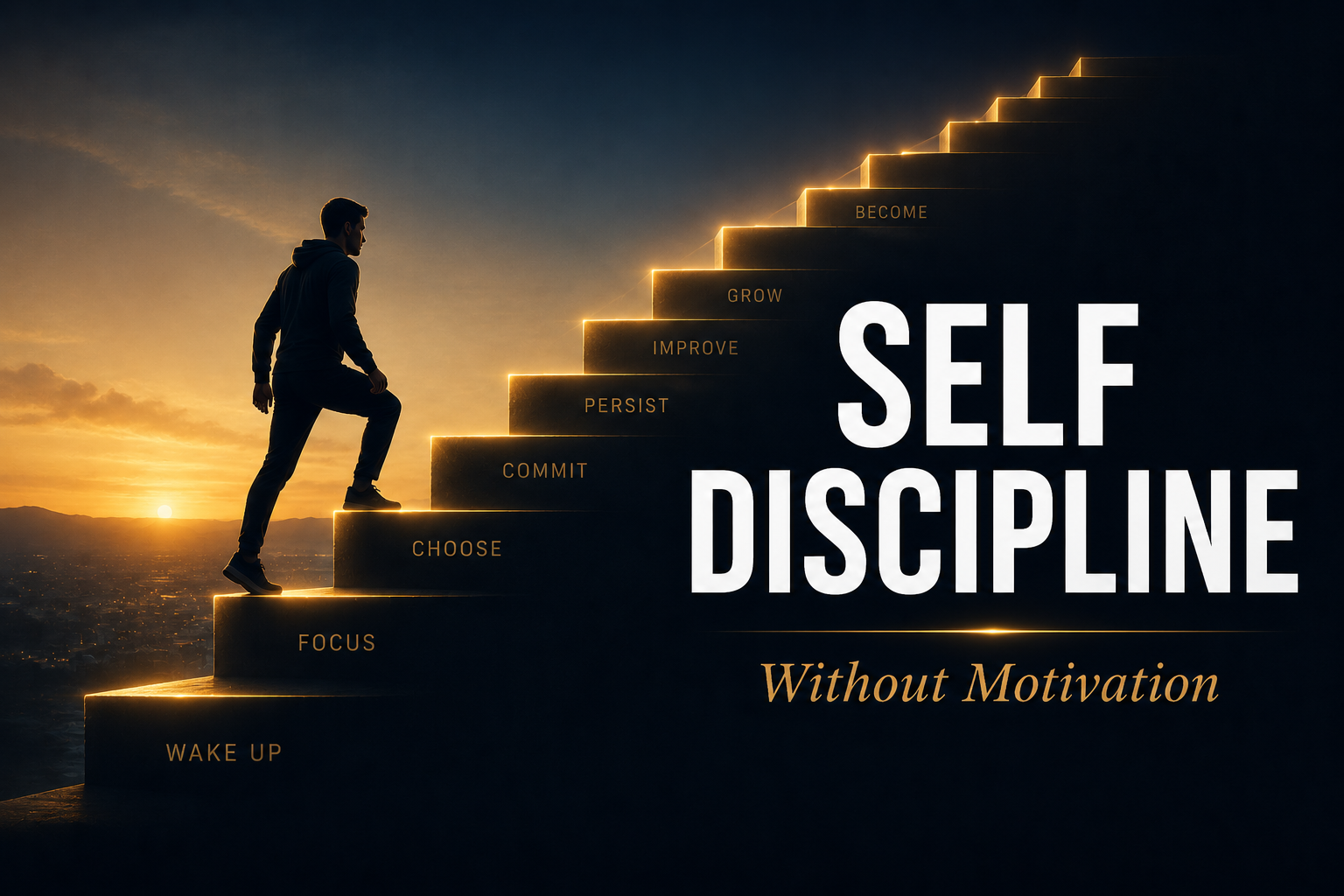
Let me guess. You woke up today promising yourself you’d finally do the thing — the workout, the work, the deep practice, the boring necessary task. By noon, you’d convinced yourself “tomorrow would be better.” By night, you were back to scrolling, hating yourself for it.
If that sounds familiar, you’re not lazy. You’re not broken. You’re just relying on the one thing that will always fail you: motivation.
After more than a decade studying human behavior, habits, and high performers, I’ve come to a conclusion that flips conventional wisdom upside down. The most disciplined people on earth aren’t disciplined because they have more motivation than you. They’re disciplined because they’ve built a system that doesn’t need motivation at all.
In this article, I’ll show you exactly how to build self discipline when you have zero motivation — using strategies grounded in psychology, not pep talks. By the end, you’ll understand why motivation is a trap, and how to build the kind of discipline that actually lasts.
Why Motivation Is the Worst Foundation for Self Discipline
Here’s the lie almost every self-help video sells you: “Just stay motivated and you’ll succeed.”
This is nonsense. Motivation is an emotion, and emotions are temporary by design. Nobody feels motivated 365 days a year. Even Olympic athletes, billionaire founders, and bestselling authors admit they often don’t feel like doing the work. The difference? They do it anyway.
Research published on the American Psychological Association consistently shows that long-term behavior change is driven by environment, systems, and identity — not feelings. Yet most people keep waiting for motivation to arrive like a delivery package. It never comes on time, and when it does, it’s gone in hours.
True self discipline begins the day you stop relying on motivation entirely.
What Self Discipline Actually Is (And What It Isn’t)
Most people misunderstand self discipline. They think it’s about willpower — forcing yourself to do things you hate through brute mental force. That definition is exhausting and unsustainable.
Real self discipline is something much simpler: the ability to do what you said you’d do, long after the mood you said it in has passed.
It’s not punishment. It’s not suffering. It’s not pushing yourself harder. It’s actually the opposite — it’s making the right behavior so easy and automatic that you don’t have to fight yourself anymore.
The disciplined person isn’t grinding through life on willpower. They’ve simply designed their life so the right action requires less effort than the wrong one.
The Hidden Cost of Living Without Self Discipline
Before we get to the strategies, let’s be honest about what’s at stake. People underestimate the cost of poor discipline because the price is paid slowly, in invisible ways.
- Goals abandoned over and over until you stop believing in yourself
- Years lost waiting for the “right moment” that never arrives
- Health deteriorating from habits you keep meaning to change
- Relationships damaged by promises you can’t keep — even to yourself
- A quiet, growing shame that erodes your confidence and self-worth
Undisciplined people aren’t failing because they lack talent. They’re failing because they keep betraying themselves in small ways, every single day. That’s the real cost — and it compounds, much like small daily improvements compound through the 1% Rule, but in the opposite direction.
8 Proven Ways to Build Self Discipline Without Motivation
Here are the techniques I’ve seen actually work — in real people, with real lives, with zero need for motivation. Pick two to start. Don’t try them all at once.
1. Lower the Bar Until You Can’t Say No
This is the single most powerful technique to build self discipline, and almost nobody uses it. The reason your discipline fails isn’t that you’re not trying hard enough — it’s that you’re trying way too hard.
You promise yourself a 1-hour workout. You can’t do it. So you do nothing.
What if you promised 2 minutes instead? You can’t fail at 2 minutes. And 95% of the time, once you start, you keep going. The bar wasn’t too low — it was just low enough to actually start.
Disciplined people are masters of starting small. They know that consistency beats intensity every single time.
2. Design Your Environment to Win the Battle for You
You’re not in a fight with your habits — you’re in a fight with your environment. And your environment wins almost every time.
If your phone is next to your bed, you’ll scroll. If junk food is in your kitchen, you’ll eat it. If Netflix opens automatically on your laptop, you’ll watch. None of this is a willpower problem. It’s a design problem.
Real discipline isn’t about resisting temptation. It’s about removing it. Put the phone in another room. Throw out the junk food. Log out of distracting accounts. The strongest discipline is making the bad choice harder than the good one.
3. Use the 2-Minute Rule to Start Anything
Most failures happen at the starting line. You don’t actually hate working out — you hate starting. You don’t hate writing — you hate opening the blank page.
The 2-minute rule fixes this. Whenever you don’t feel like doing something, tell yourself: “I just have to do it for 2 minutes. Then I can quit.”
Here’s what happens. Once you start, momentum kicks in. Newton was right — objects in motion stay in motion. Your only job is to get into motion. Discipline takes care of the rest.
4. Anchor New Habits to Old Ones (Habit Stacking)
Trying to remember new habits is exhausting. Your brain has limited willpower in a day, and it’s gone faster than you think.
The solution? Don’t rely on memory. Attach the new habit to something you already do without thinking.
- After I pour my morning coffee → I will read for 10 minutes.
- After I brush my teeth at night → I will plan tomorrow.
- After I close my laptop from work → I will go for a walk.
This is called habit stacking, and it transforms self discipline from a daily decision into an automatic chain reaction.
5. Track It — Or You Won’t Do It
What gets measured gets done. What’s invisible gets ignored. This is one of the oldest truths in psychology, and most people still ignore it.
Get a calendar. Every day you complete your habit, mark a big X. Within a week, the chain of X’s becomes its own motivation. You won’t want to break the streak.
This sounds almost too simple to work. That’s the point. The most disciplined people in history — from Jerry Seinfeld writing jokes daily to Olympic athletes logging workouts — have used this exact method. It works because it makes your progress visible to the part of your brain that responds to evidence, not promises.
6. Reframe Discomfort as Growth, Not Suffering
Undisciplined people see discomfort as a signal to stop. Disciplined people see it as a signal to keep going. This single mental shift changes everything.
When you feel resistance during a workout, that’s your muscles getting stronger. When you feel boredom while studying, that’s your focus muscle being trained. When you feel reluctance to start, that’s your discipline being forged in real time.
The pain isn’t a problem. It’s the price. And the price is always worth paying — because the alternative is the much larger pain of regret. Short-term discomfort is the foundation of long-term freedom.
7. Use the “Identity-First” Approach
Most people try to change their behavior first and expect identity to follow. This almost always fails. The disciplined people I’ve studied do the opposite — they decide who they are first, and the behavior follows naturally.
Don’t say: “I’m trying to work out more.”
Say: “I am someone who trains.”
Don’t say: “I’m trying to read more.”
Say: “I am a reader.”
Don’t say: “I’m trying to stop procrastinating.”
Say: “I am someone who acts on what matters.”
Every small action becomes a vote for that identity. And over time, the votes pile up until the identity becomes undeniable. This is also why understanding how cognitive biases secretly shape our decisions is so important — most identity-based change fails because of biases we never noticed.
8. Forgive Yourself, Then Get Back Up Faster
Here’s the rule that separates the disciplined from everyone else: you’re allowed to miss once. You’re never allowed to miss twice.
Missing one day is human. Missing two days is the start of a new habit — the habit of not doing. And once that habit starts, it spreads faster than you can imagine.
Disciplined people don’t beat themselves up when they slip. That’s a waste of energy. They simply restart, immediately, without drama. The willingness to begin again — without shame, without delay — is itself the highest form of discipline.
Why Most Self Discipline Advice Fails
If you’ve tried to build self discipline before and failed, it’s probably not your fault. Most advice fails for three predictable reasons.
It Treats Discipline Like a Personality Trait
Discipline isn’t something you’re born with. It’s something you build through repetition. Research from Harvard Health shows willpower is more like a muscle than a fixed trait — it strengthens with use and weakens when overused.
It Demands Massive Change Overnight
“Wake up at 5 AM, cold shower, journal, meditate, gym, no phone for 2 hours.” This is a failure recipe. You’re trying to change 10 habits at once. You’ll break in 4 days. Pick ONE. Master it. Then add the next.
It Confuses Punishment with Discipline
True discipline isn’t punishment. It’s a deep form of self-respect. You discipline yourself because you care about who you’re becoming — not because you hate who you are. If your discipline comes from self-loathing, it won’t survive a hard week.
The Truth About Self Discipline Nobody Tells You
Here’s something I wish someone had told me years ago: self discipline isn’t about doing more — it’s about wanting less.
The disciplined person isn’t constantly fighting urges. They’ve simply stopped wanting the things that don’t serve them. They’ve trained their mind to find satisfaction in what’s actually meaningful — work that matters, relationships that nourish, growth that compounds.
That kind of discipline doesn’t feel like restriction. It feels like freedom.
And the only way to get there is the slow, unglamorous, daily practice of choosing the harder right over the easier wrong. Hundreds of times. Without an audience. Without applause.
Most people never make that choice consistently. The ones who do build lives most people only dream about.
Your First Step Toward Real Self Discipline
You don’t need motivation to change your life. You need a starting point so small that even your worst self can’t refuse it.
Pick one habit. Make the bar embarrassingly low. Anchor it to something you already do. Track it for 30 days. Restart immediately when you slip.
That’s it. That’s the whole game.
Self discipline isn’t built in a moment of inspiration. It’s built in the dozens of ordinary moments where you choose to do the boring right thing — when nobody’s watching, when nothing feels exciting, when motivation is nowhere to be found.
One year of those small choices will produce someone you barely recognize. Five years will produce a life most people only fantasize about.
The disciplined version of you is not a different person. It’s just the current you, repeating one small promise to yourself, every day, for long enough that the world has to change with you.
What’s the one habit you’ve been promising yourself for too long? Drop it in the comments — sometimes saying it out loud is the first step to keeping it.