
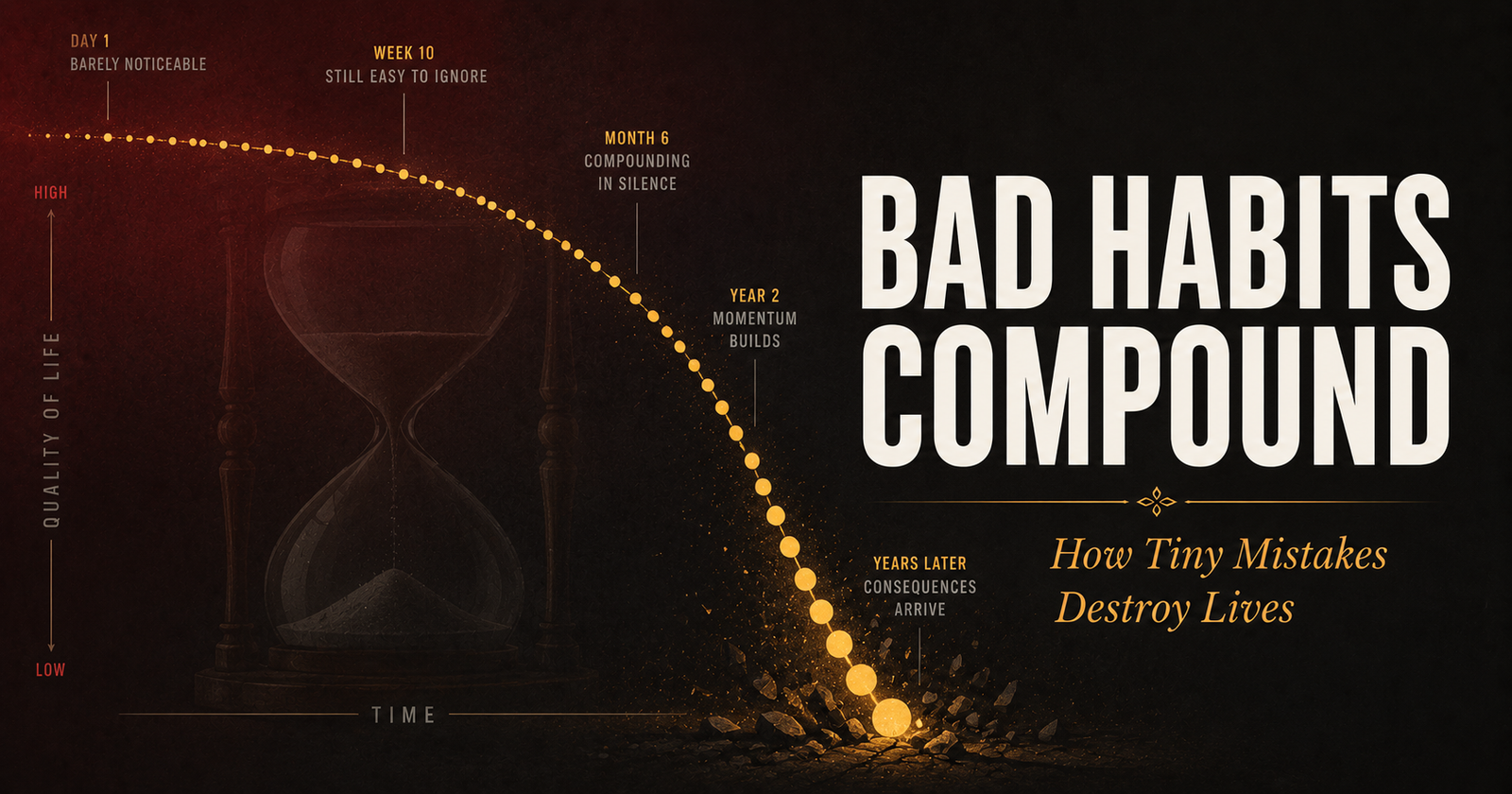
Nobody ruins their life in a single day. That’s the first thing you need to understand. The person who’s broke, overweight, lonely, addicted, or stuck didn’t become that way overnight. They became that way the same way buildings collapse — slowly at first, then suddenly, then irreversibly.
Every bad habit operates on a hidden mathematical principle most people never realize is at work. It’s the same principle that makes compound interest one of the most powerful forces in finance. Except in this case, it’s the most destructive force in human behavior — and it’s quietly shaping your life right now, whether you see it or not.
After more than a decade studying habits, behavior, and how lives actually unravel, I’ve come to one chilling conclusion. Bad habits compound just like good ones — but in the opposite direction. And because they feel so small in any given moment, almost no one notices what they’re truly costing until the damage is done.
In this article, I’ll show you exactly how bad habits compound into life-altering consequences, the science behind why your brain ignores the slow damage, and how to reverse the cycle before it costs you the future you actually want.
The Hidden Math of Bad Habits
Most people understand compound interest in finance — a small amount of money invested consistently grows into something enormous over time. But almost no one realizes the same math applies to behavior. The tiny, repeated choices you make every day compound — for better or for worse — into outcomes most people consider random fate.
This is the principle behind the 1% Rule and how small daily improvements stack into massive results. The same equation works in reverse with terrifying precision. Get 1% worse at something every day, and within a year, you’re a fraction of what you could have been. Within five years, you’re someone else entirely.
Skip the gym once. No big deal. Skip it consistently for 365 days, and you’ve aged your body by years. Eat junk food once. Harmless. Eat it daily for a decade, and you’ve quietly engineered the diseases that will eventually arrive. Spend an extra hour on your phone. Trivial. Spend it daily and you’ve donated 365 hours — entire weeks — to scrolling that you’ll never get back.
Bad habits don’t ruin lives in moments of weakness. They ruin lives in moments of weakness repeated thousands of times.
Why Your Brain Is Wired to Ignore Slow Damage
If the math is so clear, why don’t people see what’s happening to them? Because human brains were not designed to perceive slow change. We evolved to spot predators, not patterns.
Research from Harvard Health shows that humans systematically underestimate cumulative damage from repeated small behaviors. We see weight gain only when it’s already significant. We notice declining health only when symptoms appear. We feel the effect of bad relationships only after years of erosion. The damage was always there. Our brains just couldn’t process it in real time.
This is the cruelest part of how bad habits compound. They’re invisible in the day they happen and devastating in the year they finish. By the time you can see the damage, you’re already paying for it.
The 5 Most Destructive Bad Habit Patterns
After watching this play out in real lives for years, the same patterns repeat. Here are the most common ways bad habits compound — and almost everyone has at least two of these running silently in their life right now.
1. Daily Distraction That Erodes Your Mind
The hours spent scrolling, refreshing, and consuming low-value content add up faster than any other habit. Two hours a day equals 14 hours a week, equals 60 hours a month, equals nearly 730 hours a year — over 30 entire days of your one life spent staring at content you won’t remember a week later.
The deeper damage isn’t just the time lost. It’s what those hours do to your attention span, your ability to focus, and your capacity for deep thought. You don’t just lose time. You lose the kind of mind that could have done meaningful things with it.
2. Small Financial Leaks That Eat Your Future
The daily coffee. The subscription you forgot about. The impulse purchases. The unnecessary upgrades. Individually, each feels harmless. Together, they’re the reason most people stay financially stuck for decades.
₹200 a day equals ₹73,000 a year, equals around ₹7.3 lakh over a decade — not counting the investment growth that money could have generated. The math is unforgiving. The leaks feel small. The accumulated cost is staggering. This connects directly to the psychology of money — most financial damage comes from invisible patterns, not dramatic decisions.
3. Unprocessed Emotions That Become Personality
Every time you avoid a difficult feeling — burying anger, ignoring grief, suppressing fear — it doesn’t disappear. It accumulates. Over years, unprocessed emotions don’t just hurt you — they become you. The chronic anxiety. The unexplained anger. The relationship patterns that keep repeating. The numbness you can’t shake.
Most adult struggles aren’t caused by current events. They’re caused by emotions from years ago that compounded silently in the dark. The work isn’t to fix today’s feelings. It’s to process the backlog before it shapes another decade.
4. Toxic Comparison That Steals Your Joy
Every time you check social media and compare your real life to someone else’s curated highlights, your brain absorbs a small dose of inadequacy. Once a day, harmless. Hundreds of times a day for years, devastating.
Studies referenced on the American Psychological Association consistently link chronic social media use with rising depression, anxiety, and loss of self-worth. The damage isn’t from any single scroll. It’s from the cumulative weight of comparison your nervous system was never designed to handle.
5. Skipped Small Discipline That Erases Self-Trust
Every time you break a promise to yourself — skipping the workout, abandoning the project, breaking the diet — you weaken the relationship between you and you. The damage isn’t the skipped action. It’s the message it sends to your subconscious: I can’t trust myself to follow through.
After enough of these, self-trust erodes completely. You stop believing in your own commitments. You start expecting yourself to fail. And once that belief is in place, every future attempt is sabotaged before it begins. This is why building real self-discipline isn’t about willpower — it’s about restoring the trust you’ve been quietly losing.
Why Most People Don’t Fix Their Bad Habits
The math of bad habits is clear. The damage is visible — eventually. So why does almost no one actually change them? Three reasons, all of them human.
The Pain Is Delayed
The reward of a bad habit is immediate. The cost is distant. Eating junk food feels great now. The disease arrives in 20 years. Scrolling feels great now. The eroded attention shows up later. By the time consequences arrive, the cause has been forgotten. The brain doesn’t connect them.
The Cost Feels Survivable Daily
Any single day of a bad habit feels survivable. “One more day won’t matter.” That single sentence is the most dangerous thing humans tell themselves. Of course one more day won’t matter. But you’ll say the same thing tomorrow. And the day after. And in a thousand days, you’ll wonder where the damage came from.
The Identity Has Already Adapted
Eventually, bad habits stop feeling like behaviors and start feeling like identity. “I’m just not a morning person.” “I’m bad with money.” “I can’t focus.” These aren’t facts. They’re stories built from accumulated bad habits. But once an identity is in place, changing the behavior feels like betraying who you are. Most people pick familiarity over transformation, every single time.
How to Reverse the Compound Damage
The good news is that the same math that destroys works in reverse. Reversing bad habits doesn’t require dramatic transformation. It requires the same small consistency that created the damage — applied in the opposite direction.
Target One Bad Habit at a Time
Most people try to fix five things at once and fail at all of them. Pick the single most damaging habit in your life — the one whose compounding cost is highest. Focus only there. Once that one is under control, move to the next. Real change is sequential, not parallel.
Make the Bad Habit Harder
You don’t need more willpower. You need more friction. Put the phone in another room. Cancel the subscription. Delete the app. Throw out the junk food. Every small piece of friction reduces the chance of repeating the habit. You’re not fighting your habit. You’re fighting your environment. Win the environment, and the habit usually surrenders.
Replace, Don’t Just Remove
Bad habits usually fill an emotional need — boredom, stress, loneliness, anxiety. If you remove the habit without replacing it, the underlying need still exists, and another bad habit will fill the gap. Replace the scroll with a walk. Replace the snack with water. Replace the comparison with a journal. The need stays. Only the answer changes.
Track the Reversal
Just like the original 1% Rule, mark a calendar every day you don’t repeat the bad habit. Make the progress visible. The chain of X’s becomes its own motivation. Within weeks, the new pattern starts feeling more natural than the old one. The compound effect begins to work for you instead of against you.
Stay Patient With the Math
The damage compounded for years. The reversal will compound too — but slowly at first. Don’t expect dramatic change in 30 days. Expect quiet, steady recovery over months. The same forces that ruined the life can rebuild it — given the same patience.
The Truth About Bad Habits Nobody Tells You
Here’s the deepest truth I’ve learned about this. The version of you in five years is being built right now, by the bad habits you’re ignoring today. Not the ones you’re planning to fix “soon.” The actual ones running in the background of your life this week.
Most people are walking toward a future shaped almost entirely by behaviors they’ve decided don’t matter. They will arrive at that future shocked. They’ll blame circumstances. They’ll wonder how they ended up there. The math will know. The math always knew.
You don’t have to be one of those people. The same equation that’s been quietly working against you can start working for you the moment you decide to interrupt even one bad pattern. Not perfectly. Not heroically. Just consistently. The math doesn’t care about your motivation. It only cares about your repetition.
Your First Step to Reversing the Damage
Pick one bad habit. Just one. The most damaging one — the one whose cost frightens you most if you imagine it compounding for another five years untouched.
Don’t promise to eliminate it. Just commit to interrupting it once today. One skipped scroll session. One avoided snack. One refused impulse purchase. One unspoken comparison. Whatever it is, break the chain once. Then again tomorrow. Then again the day after.
You won’t feel transformation. You won’t see results. The math won’t reveal itself for weeks. But it’s working — silently, exactly the way it worked when the bad habit was destroying you. Now it’s healing you instead. Same math. Different direction.
The future version of you isn’t waiting at the end of some massive change. It’s being assembled right now, in the small choices you don’t think matter. They always mattered. They always will. The only question is which direction the compound effect is going to take you — and that question is being answered today, whether you’re paying attention or not.
The good news is, you can start paying attention right now. And once you do, everything changes — quietly at first, then visibly, then completely.
What’s the one bad habit whose compound damage scares you most? Drop it in the comments — sometimes naming it is the first step to finally stopping it.