
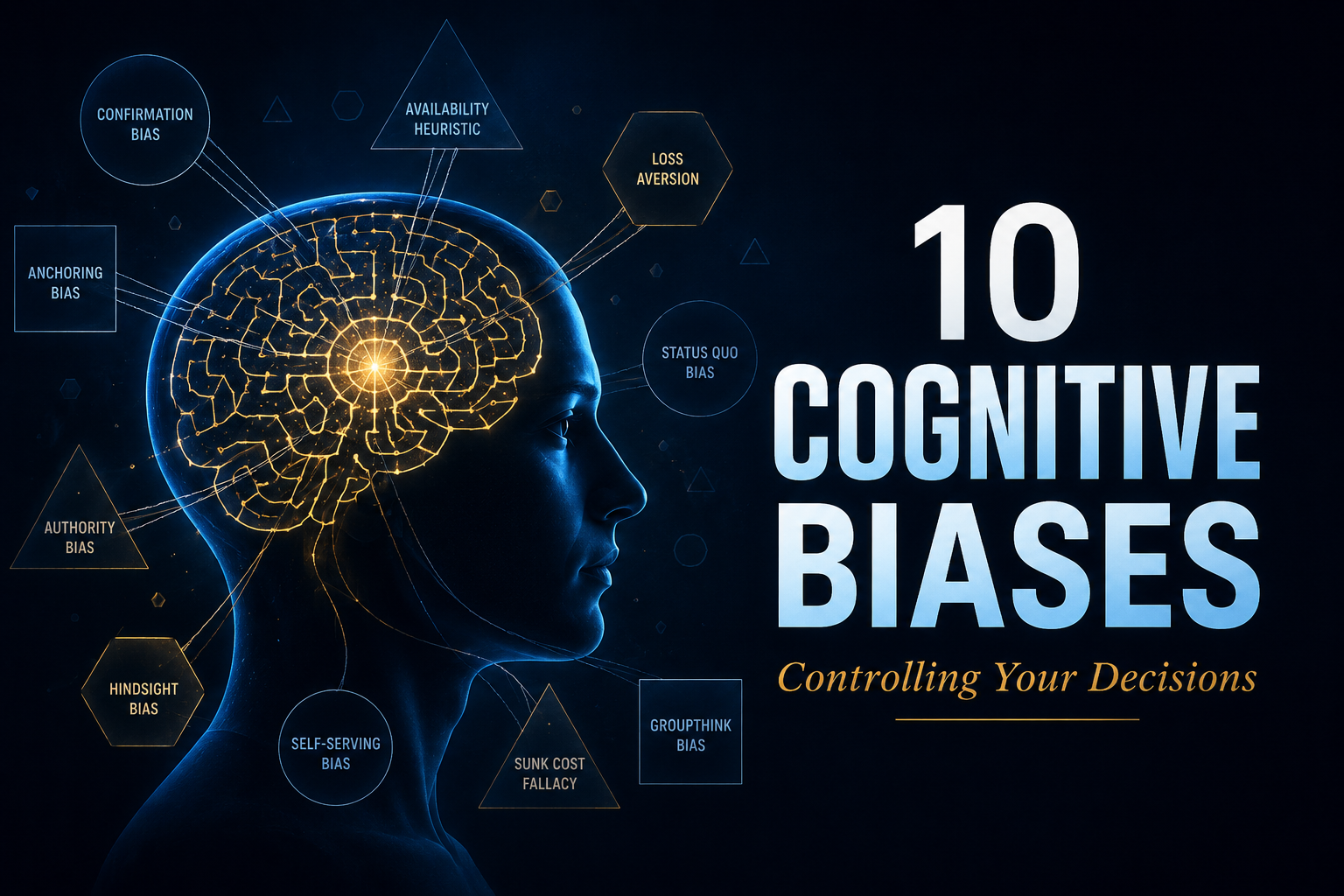
Here’s something uncomfortable to think about: most of the decisions you made today weren’t really yours.
I know that sounds dramatic, but stick with me. After more than a decade studying human psychology and decision-making, I’ve come to one unsettling conclusion — our brains are running ancient software in a modern world. And that software has bugs. Lots of them.
These bugs are called cognitive biases, and they quietly shape everything: what you buy, who you trust, what you believe, who you marry, how you vote, and what you think about yourself. The scariest part? You almost never notice them happening.
In this article, I’m going to walk you through 10 of the most powerful cognitive biases that are secretly controlling your decisions right now. Once you see them, you can’t unsee them — and that’s the first step toward thinking clearly in a world designed to manipulate you.
What Exactly Is a Cognitive Bias?
A cognitive bias is a systematic error in thinking that affects how you perceive the world and make decisions. It’s not stupidity. It’s not laziness. It’s how the human brain is wired to work — efficiently, but not always accurately.
Your brain processes roughly 11 million bits of information every second, but you’re only consciously aware of about 40 of them. To survive, your brain takes mental shortcuts called heuristics. These shortcuts usually work — until they don’t.
When these shortcuts fail, they become biases. And in modern life, they fail constantly.
Let me show you what I mean.
1. Confirmation Bias: You See What You Want to See
This is the king of all biases. Confirmation bias is your brain’s tendency to seek out, remember, and trust information that confirms what you already believe — while ignoring everything that contradicts it.
Think about the last time you researched something. A diet, a political view, a stock to buy. Did you genuinely look for evidence against your opinion? Or did you just collect arguments that proved you were right?
This is why people in echo chambers become more extreme over time. They’re not lying. Their brains are literally filtering reality.
The fix: Once a week, deliberately read something written by someone you disagree with. Not to argue. Just to understand.
2. The Dunning-Kruger Effect: The Less You Know, The More Confident You Feel
Have you ever noticed that the most confident people in the room are often the least qualified? That’s not coincidence — that’s the Dunning-Kruger Effect at work.
When you don’t know much about a topic, you also don’t know what you don’t know. So you feel confident. As you learn more, you start realizing how complex the topic actually is, and your confidence drops. Real experts often sound the most uncertain because they understand the nuance.
This is why beginners often think they’re experts after watching three YouTube videos, while genuine experts say things like “it’s complicated.”
The fix: When you feel certain about something, ask yourself: “How much do I actually know about this?” The answer will humble you.
3. Availability Heuristic: What You Remember Feels More Likely
Your brain judges how likely something is based on how easily you can remember examples of it. The problem? Memorable things aren’t always common things.
After watching news about a plane crash, you suddenly feel scared to fly — even though statistically, driving to the airport is far more dangerous. After hearing about a shark attack, you avoid the beach for weeks. After your friend’s startup fails, you decide entrepreneurship is too risky.
None of these decisions are based on actual probability. They’re based on vividness.
The fix: Before making a fear-based decision, ask: “What does the actual data say?” Usually, reality is far less scary than your memory suggests.
4. Anchoring Bias: The First Number Wins
This one shapes negotiations, shopping, and almost every financial decision you make.
Anchoring bias is your brain’s tendency to over-rely on the first piece of information it receives. That first number becomes the “anchor,” and everything else gets judged relative to it.
This is why a shirt marked “Was ₹3,000, now ₹999” feels like a steal — even if ₹999 is still overpriced. The ₹3,000 anchor makes ₹999 look amazing. Without the anchor, you’d probably walk away.
Salaries, house prices, restaurant menus, even first impressions of people — all of it is shaped by the first number or impression you encounter.
The fix: When negotiating or shopping, set your own anchor first. Decide what something is worth to you before you see any prices.
5. Sunk Cost Fallacy: Throwing Good Money After Bad
You’ve probably been guilty of this one many times. The sunk cost fallacy is your brain’s refusal to abandon something you’ve already invested time, money, or effort into — even when continuing makes no sense.
You finish watching a bad movie because you’ve already sat through an hour. You stay in a job you hate because you’ve spent five years there. You don’t leave a toxic relationship because of all the years invested.
Here’s the truth: the money and time are already gone. They’re not coming back regardless of what you do next. The only question that matters is: from this point forward, what’s the best decision?
The fix: Ask yourself: “If I were starting fresh today, knowing what I know now, would I make this choice?” If the answer is no, walk away.
6. The Halo Effect: One Good Trait Makes Everything Look Good
If someone is good-looking, your brain assumes they’re also smart, kind, and competent. If someone has an impressive job title, you assume they know what they’re talking about — even on topics outside their expertise.
This is the halo effect, and it’s why marketing works so well. Celebrities endorse products they’ve never used, and we believe them. Attractive politicians win more votes. Tall CEOs get higher salaries.
The same applies in reverse. One negative trait can poison your perception of everything about a person.
The fix: Evaluate people and ideas trait by trait, not as a whole. Just because someone is good at one thing doesn’t mean they’re good at everything.
7. Negativity Bias: Bad News Sticks More Than Good News
Your brain evolved in a dangerous world where missing a threat could mean death, but missing a positive event was no big deal. So evolution wired you to pay much more attention to negative information than positive.
This is why one critical comment ruins ten compliments. Why bad news goes viral. Why we remember insults for years but forget kind words by morning.
In a world of endless negative news, this bias is silently destroying mental health on a massive scale.
The fix: At the end of each day, deliberately recall three good things that happened. Your brain will fight you on this — do it anyway.
8. The Bandwagon Effect: If Everyone’s Doing It, It Must Be Right
Humans are tribal creatures. When you see lots of people doing something — buying a stock, following a trend, believing an idea — your brain takes it as evidence that the thing must be valid.
This is the bandwagon effect, and it’s why bubbles form, fads spread, and dangerous ideologies catch on. Most people don’t think for themselves; they look around and copy the herd.
Markets crash, cults grow, and entire countries make terrible decisions because of this single bias.
The fix: When something is wildly popular, ask: “Is it popular because it’s good, or am I just being pulled by the crowd?” Real thinking happens against the grain.
9. The Spotlight Effect: You Think Everyone’s Watching
You spilled coffee on your shirt at work. You said something awkward at dinner. You walked into the wrong meeting room. And now you’re replaying it in your head, certain everyone noticed.
The truth? Almost no one noticed. They were too busy worrying about themselves.
This is the spotlight effect — our tendency to overestimate how much other people pay attention to us. We’re the main character of our own life, so we assume we’re a main character in everyone else’s. We’re not.
Realizing this is genuinely liberating. The embarrassment you carry around is mostly fiction.
The fix: Next time you feel self-conscious, remind yourself: “Everyone is too worried about themselves to care about my mistake.”
10. Loss Aversion: Losing Hurts Twice as Much as Winning Feels Good
Psychologists Daniel Kahneman and Amos Tversky discovered something fascinating: the pain of losing ₹1,000 is roughly twice as intense as the pleasure of gaining ₹1,000.
This is loss aversion, and it explains so much irrational behavior. Why we hold onto bad investments hoping they’ll recover. Why we stay in comfortable but unfulfilling lives. Why we’d rather not lose what we have than risk gaining something better.
Loss aversion is the invisible chain keeping millions of people stuck in med