
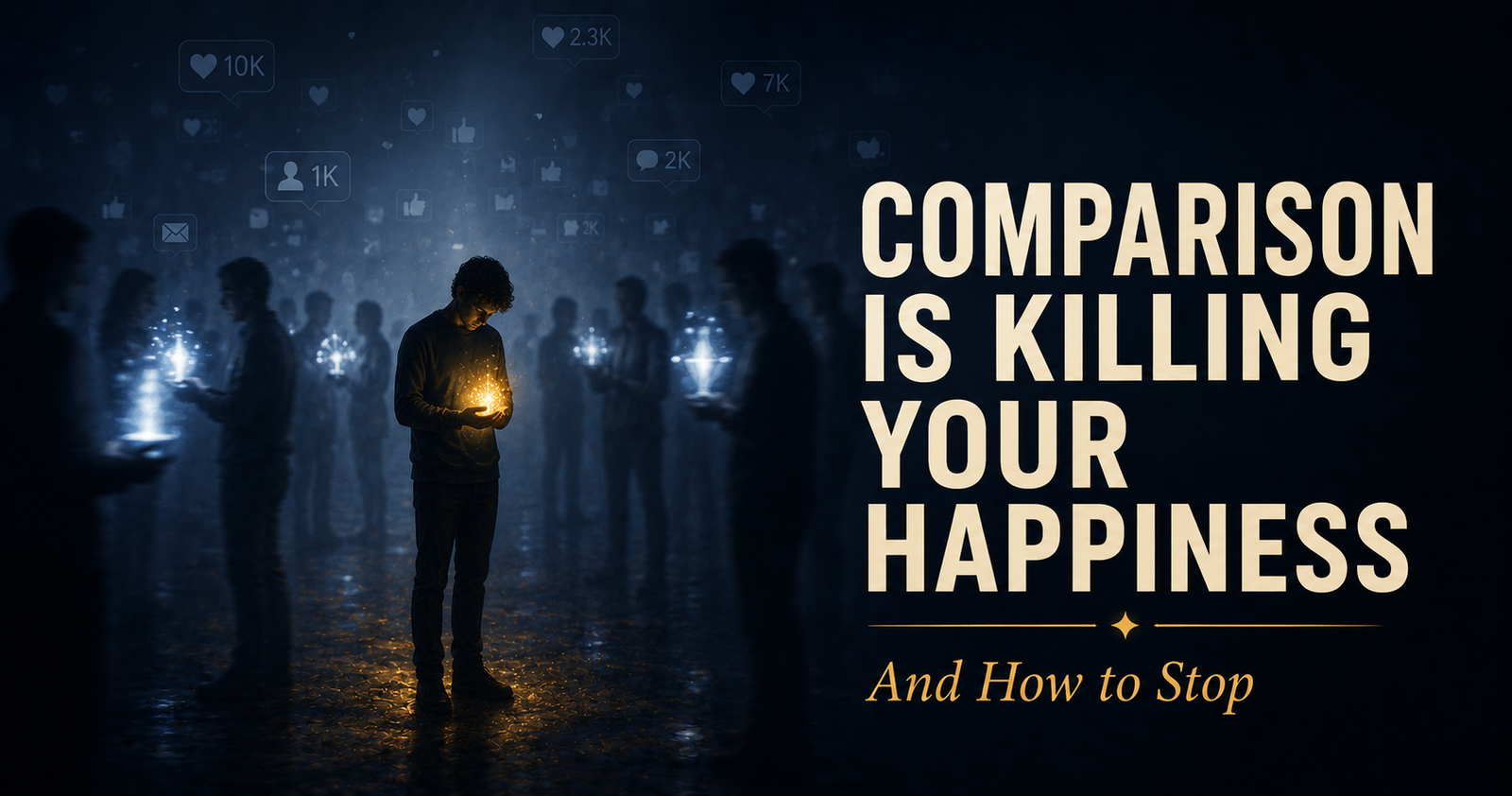
Why Comparison Is Killing Your Happiness (And How to Stop)

You scrolled through social media this morning. Within minutes, you saw someone traveling, someone getting engaged, someone starting a company, someone in better shape, someone earning more, someone happier than you’ll ever be. You didn’t consciously feel jealous. You just felt a small quiet tightening — a whisper of “I’m behind.”

Multiply that whisper by the 80 times you check your phone daily, the countless people whose highlight reels you consume every week, the endless stream of comparisons your brain quietly makes without your permission. Within a year, that whisper has become the background music of your entire life. And your happiness has been slowly, systematically dismantled — not by any real failure, but by the daily poison of comparing your reality to other people’s edited versions.

After more than a decade studying psychology, behavior, and what genuinely happy people do differently, I’ve come to a devastating conclusion. Comparison is not just harmful — it is the single most efficient destroyer of human happiness in the modern world. Nothing else even comes close. Not money problems. Not relationship issues. Not health concerns. Just the daily habit of measuring your life against everyone else’s.

In this article, I’ll walk you through why comparison is killing your happiness, the neuroscience behind why your brain can’t stop doing it, and the practical, honest ways to break free — not through positive affirmations, but through real psychological shifts that actually work.

Why Your Brain Can’t Stop Comparing

First, let’s take the guilt off the table. If you compare yourself constantly, you’re not vain or shallow. You’re human. Comparison is hardwired into the brain because for most of history, it was essential for survival.

Ancient humans needed to know their place in the tribe. Were they eating enough compared to others? Were they respected as much as the strong hunters? Were they valuable enough that the group wouldn’t abandon them? Constant social comparison was a survival tool. The tribe member who never compared themselves to others often ended up ostracized — which, in prehistoric times, meant death.

Your modern brain still runs this ancient software. Every time you see another human, your brain automatically asks: Am I doing better or worse than them? You don’t choose to do this. It happens beneath awareness, thousands of times a day. The problem isn’t that you compare. The problem is what you’re comparing yourself to. Research from the American Psychological Association shows that in the age of social media, the brain is comparing your entire real life to curated highlights of hundreds of other people — a comparison it was never designed to survive.

What Comparison Actually Does to Your Brain

Here’s what almost nobody understands about social comparison. It doesn’t just make you feel bad in the moment. It rewires how your brain processes reality.

Every time you compare yourself unfavorably to someone, your brain releases small amounts of cortisol (the stress hormone) and reduces dopamine (the reward chemical). Over months and years of repeated comparison, this pattern becomes chronic. Your baseline mood drops. Your capacity for joy in your own life shrinks. The things that used to make you happy start feeling insufficient because your brain is constantly measuring them against the fabricated best of everyone else.

You didn’t stop enjoying your life. Comparison quietly convinced you your life wasn’t worth enjoying. That’s the mechanism. That’s why it’s so devastating. And that’s why most people can’t figure out why they feel unhappy — the cause is invisible, but its damage is total.

The Hidden Cost of Comparison-Driven Living

Most people don’t realize the full price they’re paying for chronic comparison. It’s not just occasional envy. It’s a slow theft of everything meaningful.

  • Genuine achievements feel smaller because someone always has bigger ones
  • Relationships lose depth because your attention keeps drifting to other people’s relationships
  • Career satisfaction disappears because someone your age is always further ahead
  • Physical health goals become sources of shame instead of pride
  • Ordinary joys — a good meal, a walk, a quiet evening — feel inadequate compared to everyone’s curated adventures
  • Self-worth becomes contingent on external metrics you can never fully win

Comparison doesn’t just make you unhappy about the future. It retroactively steals joy from your past and present. You look back at good times and feel they weren’t good enough. You look at your current life and feel it’s beneath what you deserve. The damage is total because comparison creates an impossible baseline — everyone else’s best moments — that no single human life can ever match.

Why Social Media Made This a Thousand Times Worse

Human beings have always compared themselves. But for most of history, the comparison pool was small — your village, your neighbors, your immediate community. You compared yourself to maybe 100 people, and you saw their real lives, not their edited ones.

Today, the average person compares themselves to thousands of curated identities every single week. You’re not comparing your kitchen to your neighbor’s kitchen. You’re comparing it to the best kitchen in the world you saw on Instagram this morning. You’re not comparing your career to your friend’s career. You’re comparing it to the founder who just sold their startup, the influencer showing off their lifestyle, the peer whose promotion was announced on LinkedIn.

The comparison pool has become infinite — and increasingly unreal. What you’re comparing yourself against isn’t even human anymore. It’s a filtered composite of everyone’s best moments, algorithmically curated to make you feel inadequate. No human life could survive that measurement. Yours can’t either. And yet you keep offering yourself to be measured. This is exactly why why you can’t focus anymore and the collapse of happiness are deeply connected — both are downstream of digital environments designed to fragment and destabilize the mind.

The 5 Deadliest Forms of Modern Comparison

Not all comparison is equal. Some forms do more damage than others. Here are the most destructive patterns most modern people fall into.

1. Comparing Your Behind-the-Scenes to Their Highlight Reel

You know your own bad days, doubts, and messy realities. You only see other people’s edited best moments. Then you compare the two. This comparison is not just unfair — it’s mathematically impossible to win. You’re comparing full documentaries to Instagram trailers.

2. Comparing Different Life Timelines

Different people arrive at different milestones at different times. The person who got married at 25 might struggle in their 40s while you flourish. The one whose career took off at 30 might plateau at 45 while you accelerate. Comparing timelines makes no sense — everyone’s life follows a unique arc, and today’s snapshot tells you nothing about tomorrow’s story.

3. Comparing to Curated Communities

If you spend time in a community of high achievers, entrepreneurs, or successful people, your brain starts treating extreme success as normal. You forget that 99% of humanity isn’t in that community. Your standards drift upward until nothing feels enough — even things that are objectively remarkable.

4. Comparing Your Weaknesses to Their Strengths

The person you envy for their public speaking probably envies someone else for their creativity. The one you envy for their body probably envies someone else for their calm mind. Nobody is winning at everything. Yet you compare your weakest area to their strongest and conclude they’re winning.

5. Comparing Your Real Life to Aspirational Content

Ads, influencer content, marketing — these exist to make you feel inadequate so you’ll buy solutions. When you compare your life to these curated realities, you’re playing a game rigged to keep you feeling behind. That’s the business model. Your unhappiness is the product being sold.

How to Actually Stop Comparing (Not the Advice You’ve Heard)

Most articles about comparison give the same tired advice — “be grateful,” “focus on yourself,” “don’t look at social media.” This is technically true but practically useless. Here’s what actually works — the shifts I’ve seen actually change people’s relationship with comparison.

1. Curate Your Inputs Ruthlessly

You can’t stop your brain from comparing. But you can control what it compares you to. Unfollow accounts that make you feel behind. Mute people whose success activates envy in you. Curate your feed with genuine intention. You’re not being weak. You’re protecting your nervous system from constant harmful inputs.

Within weeks of doing this, your baseline mood will shift dramatically. Most of your unhappiness was arriving from your feed. Change the feed, and much of the unhappiness leaves with it.

2. Practice the “Whole Life” Comparison

When you catch yourself envying someone, ask: Would I trade my entire life for their entire life? Not just the piece you envy — the whole thing. Their childhood, their relationships, their private struggles, their fears, their body, their exact circumstances.

Almost every time, the answer is no. You don’t actually want their life. You want one shiny piece of it while keeping the rest of yours. This realization dissolves envy fast — because it exposes it as an illusion.

3. Compete With Your Past Self, Not Present Others

The only fair comparison is between who you were a year ago and who you are today. That’s the only measurement you can actually influence and interpret honestly. Are you a little wiser? A little kinder? A little more disciplined? A little more at peace? That’s the scoreboard that matters. Everything else is theater.

This connects directly to the 1% Rule and how small daily improvements compound — the healthiest life is one where the only competitor you race is yesterday’s version of you.

4. Realize the Person You’re Envying Is Also Envying Someone

The influencer you follow envies someone with more followers. The rich person envies someone richer. The famous person envies someone more free. There is no top of the mountain where envy disappears. Everyone is looking up at someone. Comparison is infinite — which means chasing its resolution is a game you can never win.

The only exit is stepping off the ladder entirely. Not climbing higher. Just refusing to keep playing a rigged game.

5. Regularly Return to What Actually Matters to You

Ask yourself often: If nobody was watching, if there was no social media, if I couldn’t compare to anyone — what would I actually want in my life?

The answers are usually startlingly simple. Meaningful relationships. Work you love. Physical health. Inner peace. Enough freedom to make your own choices. These are the real ingredients of happiness. Almost none of them come from having more than others. Yet almost all of your comparison energy is spent chasing metrics that don’t produce them.

The Deepest Truth About Comparison

After years of watching people wrestle with this, I’ve come to believe something important. You cannot compare and be happy at the same time. These are mutually exclusive mental states. The moment comparison enters, happiness leaves. The moment you fully inhabit your own life, comparison loses its grip.

The happiest people I’ve studied aren’t the ones with the most impressive lives. They’re the ones who’ve stopped measuring their lives against anyone else’s. They’ve made peace with the specific human they are. They’ve decided their existence isn’t a competition. They’ve claimed the radical, deeply unmodern right to be exactly who they are without apology or comparison.

This isn’t complacency. Many of them work hard, achieve much, and grow constantly. But they don’t do it to keep up. They do it because it’s what they want. The internal motor is different. And that different motor produces both more meaningful results and infinitely more peace.

Your First Step Away From Comparison

Today, do a small experiment. For 24 hours, notice every time you compare yourself to someone else — every scroll, every glance, every internal measurement. Don’t try to stop. Just notice. You’ll be shocked how often it happens.

Then pick one specific source of comparison that’s doing the most damage — a social media account, a person in your life, a comparison habit you can’t seem to break. Cut it out for a week. Don’t dramatize. Just quietly remove it.

Within days, you’ll notice something remarkable. A small quietness returns. Your own life starts feeling slightly more sufficient. You have more attention for what’s actually in front of you. This isn’t magic. It’s what happens when the constant background noise of comparison momentarily stops.

The truth is, comparison is killing your happiness because it makes you a permanent stranger in your own life — always looking somewhere else, always measuring, always finding your existence inferior. Stepping off that treadmill isn’t easy. But every step off it returns something to you that comparison had quietly taken — your presence, your peace, your ability to actually enjoy the life you’re living.

You don’t have to have more than everyone. You don’t have to be ahead. You don’t have to prove anything. You just have to be here — fully — in the only life you’ll ever have. That life is enough. It always was. Comparison just tricked you into forgetting.

What’s one source of comparison you’re going to remove from your life this week? Drop it in the comments — sometimes naming it is the first step to finally being free of it.

Leave a Comment