
You’ve met them. The new employee who’s been at the company for three weeks and already thinks they should be running it. The relative who watched two YouTube videos and now lectures doctors about medicine. The friend who lost money trading once and now speaks about markets like Warren Buffett’s mentor.
And then there’s the opposite. The actual expert in a room who keeps saying “it’s complicated” while the loudest person dominates the conversation. The genuine professional who downplays their skill while a beginner explains it back to them confidently.
What you’re witnessing is one of the most fascinating glitches in the human mind — the Dunning Kruger Effect. And after more than a decade studying psychology, behavior, and decision-making, I can tell you this is the single most important cognitive bias to understand, because it explains so much of what’s gone wrong in the modern world.
In this article, I’ll walk you through what the Dunning Kruger Effect actually is (most people get the definition wrong), the science behind why our brains fool us this way, and exactly how to recognize it in yourself and others. Once you see it, you can’t unsee it. And once you can’t unsee it, you start thinking far more clearly than 99% of people around you.
What Is the Dunning Kruger Effect?
The Dunning Kruger Effect is a cognitive bias where people with low ability at a task overestimate their ability — while people with high ability tend to underestimate theirs. In simple words: the less you know about something, the more you think you know.
It was discovered in 1999 by two psychologists, David Dunning and Justin Kruger, after a strange incident inspired their research. A bank robber named McArthur Wheeler had robbed two banks in broad daylight without wearing a mask. When caught, he was genuinely confused. He had rubbed lemon juice on his face, believing it would make him invisible to cameras (because lemon juice can be used as invisible ink). He wasn’t joking. He genuinely believed it.
Dunning and Kruger asked the obvious question — how could someone be so wrong and so confident at the same time? Their research uncovered something disturbing about every human brain, including yours and mine. According to decades of follow-up research, this pattern repeats across nearly every domain — from grammar to logic to humor to driving ability. People who lack skill in something often lack the very skill needed to recognize their lack of skill.
Why Our Brains Trick Us This Way
The Dunning Kruger Effect isn’t about stupidity. It’s about awareness. To recognize you’re bad at something, you need the underlying knowledge of what “good” looks like. If you don’t have that knowledge yet, you have no way to measure how far you are from it.
Think about chess. A beginner thinks they’re playing well because they don’t know how much they don’t know. A grandmaster looks at the same game and immediately sees a hundred missed moves, weaknesses, and blunders. The grandmaster isn’t being humble — they’re being accurate. The beginner isn’t being arrogant — they’re being unaware.
This is the deepest cruelty of the bias. The skill needed to evaluate your performance is the same skill needed to perform well in the first place. Without one, you can’t have the other. So beginners feel certain. Experts feel uncertain. And the louder voice in the room is usually the wrong one.
The Four Stages of Competence
To fully understand the Dunning Kruger Effect, you need to know the four stages every person goes through when learning anything difficult.
1. Unconscious Incompetence
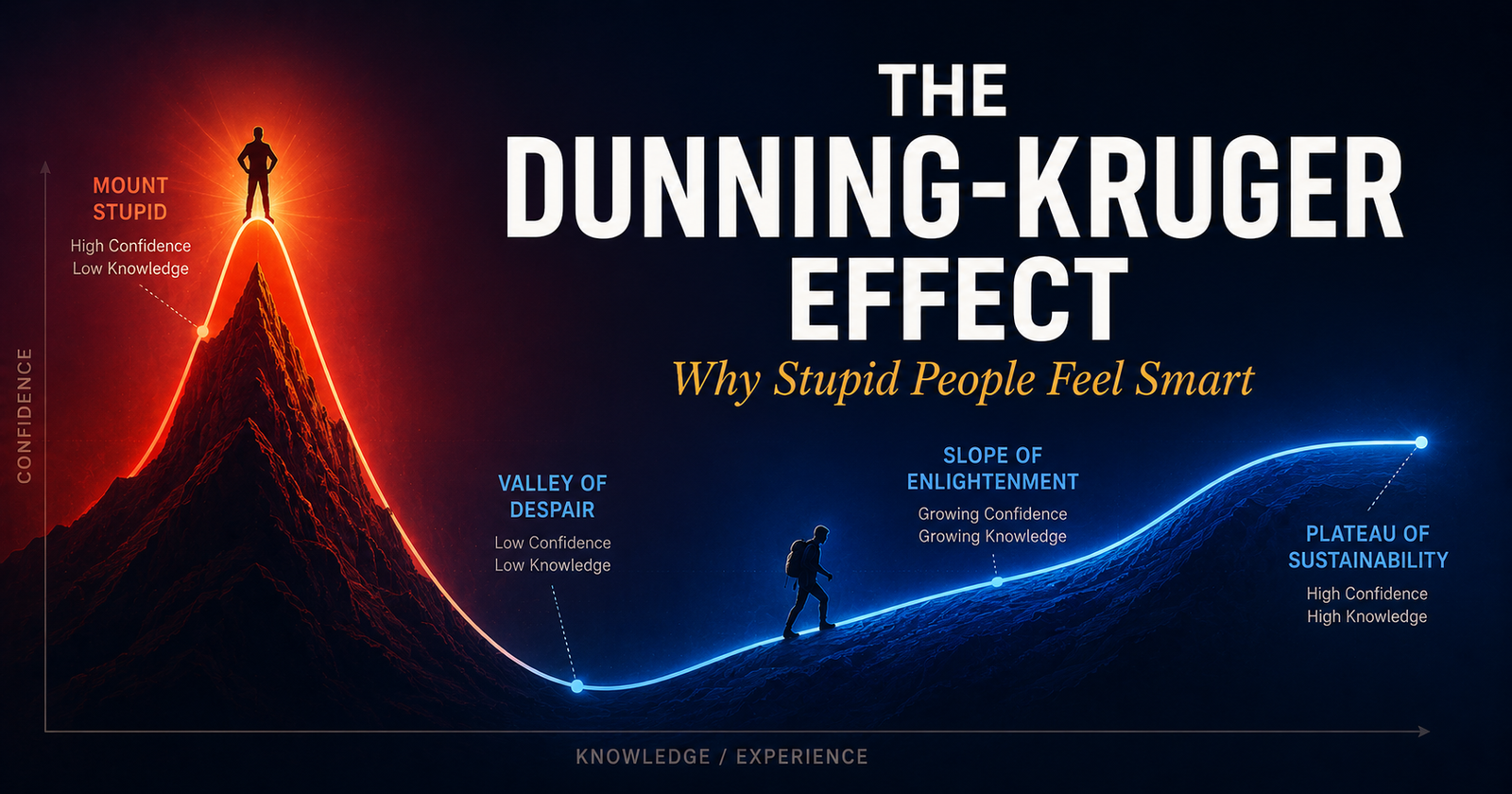
You don’t know that you don’t know. This is “Mount Stupid” — the peak of false confidence. You haven’t yet discovered how complex the subject really is, so you feel certain. Most beginners in any field live here. It feels great. It’s also dangerous.
2. Conscious Incompetence
You realize how much you don’t know. This is usually painful. Confidence drops sharply. Many people quit at this stage because they feel humiliated by their own ignorance. But this is actually the most important moment of growth — you’ve finally seen reality clearly. This is also where other cognitive biases secretly shape your decisions the most, because your brain wants to retreat back to comfortable false confidence.
3. Conscious Competence
You become genuinely skilled, but you have to think carefully about every step. You’re competent but not yet smooth. This is the long middle phase that separates the serious learners from the dabblers. Most people who reach this level stay here.
4. Unconscious Competence
You’re so skilled that the work becomes automatic. You barely have to think — you just do it well. This is the level of true experts. But here’s the catch — experts often forget what it’s like to be a beginner, which is why they’re sometimes terrible teachers.
Why the Dunning Kruger Effect Is Worse Today Than Ever
The modern world makes this bias dramatically worse — and it’s affecting everyone, including you.
Social media rewards confidence over competence. The loudest voice gets the most views. The most certain take goes viral. The actual expert who says “it’s complicated, here are five considerations” gets ignored, while a confident beginner with a hot take gets millions of likes.
Search engines and AI tools also make us feel smart without making us smart. A 5-minute Google search creates the illusion of understanding. A 10-minute video gives us enough information to feel competent — without giving us the deep grounding that real competence requires.
Research published on the American Psychological Association confirms that surface-level information consumption increases confidence faster than it increases actual ability. We’re creating a generation that feels expert in everything while being genuinely skilled in very little. The gap between confidence and competence has never been wider.
How to Recognize the Dunning Kruger Effect in Yourself
Here’s the uncomfortable part — this bias is hardest to spot in yourself. By definition, the people most affected by it can’t see it. But there are signs.
You Feel Certain About Complex Topics
The more confident you feel about a complex topic, the more you should pause. Genuine experts in fields like medicine, economics, and psychology rarely sound certain — because they understand the nuance. If you feel sure about something complicated, you might be at Mount Stupid without realizing it.
You’ve Studied It Briefly
A few articles, a few videos, a few weeks of reading — that’s usually the danger zone. Enough information to feel knowledgeable, not enough to know how much remains unknown. Real understanding often takes years.
You Dismiss Experts Easily
If your first instinct when hearing an expert is to think “they’re wrong” rather than “what am I missing?” — pause. Sometimes experts are wrong. Often, they see things you don’t. Humility is a sign of growth. Dismissal is often a sign of Dunning Kruger.
You Don’t Know What You Don’t Know
Ask yourself in any domain: What are the questions experts in this field debate? What are the trade-offs? What’s the deepest open problem? If you can’t answer, you’re not yet at conscious competence. You’re still at Mount Stupid — and that’s okay, as long as you know it.
How to Escape Mount Stupid
The goal isn’t to become humble for its own sake. The goal is to become accurate. Here’s how the people who escape this trap actually do it.
Seek Real Feedback, Not Validation
Stop sharing your work with people who agree with you. Start sharing it with people qualified to criticize it. Their honest feedback is uncomfortable but essential. The growth lives there.
Read the Experts Directly
Skip the influencer summaries. Skip the second-hand interpretations. Go to the source — original books, peer-reviewed papers, primary research. The more you read genuine experts, the more you realize how shallow most popular content actually is.
Embrace “I Don’t Know”
Three of the most powerful words in adult learning. Most people refuse to say them because they think admitting ignorance makes them look weak. The opposite is true. The strongest thinkers admit ignorance freely — because they know the alternative (pretending) is far weaker.
Stay in the Pain of Stage 2
When you realize you’re worse at something than you thought, don’t quit. That feeling is the beginning of real competence. Most people retreat back to Mount Stupid because it feels better. The ones who grow stay in the discomfort until clarity returns — but this time, the clarity is real, not imagined. This is also why building self-discipline matters more than motivation for long-term growth.
The Real Lesson of the Dunning Kruger Effect
Here’s what most people miss about this bias. It’s not about laughing at people who don’t know they’re wrong. Every single person reading this is currently overconfident about some part of their life. You don’t know which part — and you never will, until you’re past it. That’s how the trap works.
The lesson isn’t to assume you’re always wrong. The lesson is to hold your certainties more loosely. To stay curious about your own blind spots. To respect expertise even when you don’t fully understand it. To listen to the quiet, uncertain voice in the room more than the loud, confident one — because the uncertainty often means they’ve done the work to know the limits.
Real intelligence isn’t knowing more. It’s knowing more accurately what you don’t know.
Your First Step Past Dunning Kruger
Pick one topic you feel confident about. Now ask yourself honestly — how deeply have you studied it? Have you read the actual experts? Have you sat with the opposing views? Have you tried to find your own blind spots?
If the honest answer is “not really,” you’ve just identified a Mount Stupid in your own life. Don’t panic. Everyone has them. The wise just notice theirs sooner.
Becoming a clearer thinker doesn’t require being a genius. It requires being honest. Honest about your limits. Honest about your gaps. Honest about the difference between feeling smart and being smart. Most people will never make that distinction. The few who do quietly become the most accurate thinkers in every room — not by talking more, but by listening better, learning longer, and admitting freely what they don’t yet understand.
The smartest person in the room isn’t usually the most certain. It’s the one quietly asking better questions. That person can be you — starting with the next conversation you have.
What’s one topic you’ve recently realized you knew less about than you thought? Drop it in the comments — sometimes naming a Mount Stupid is the first step to climbing past it.