
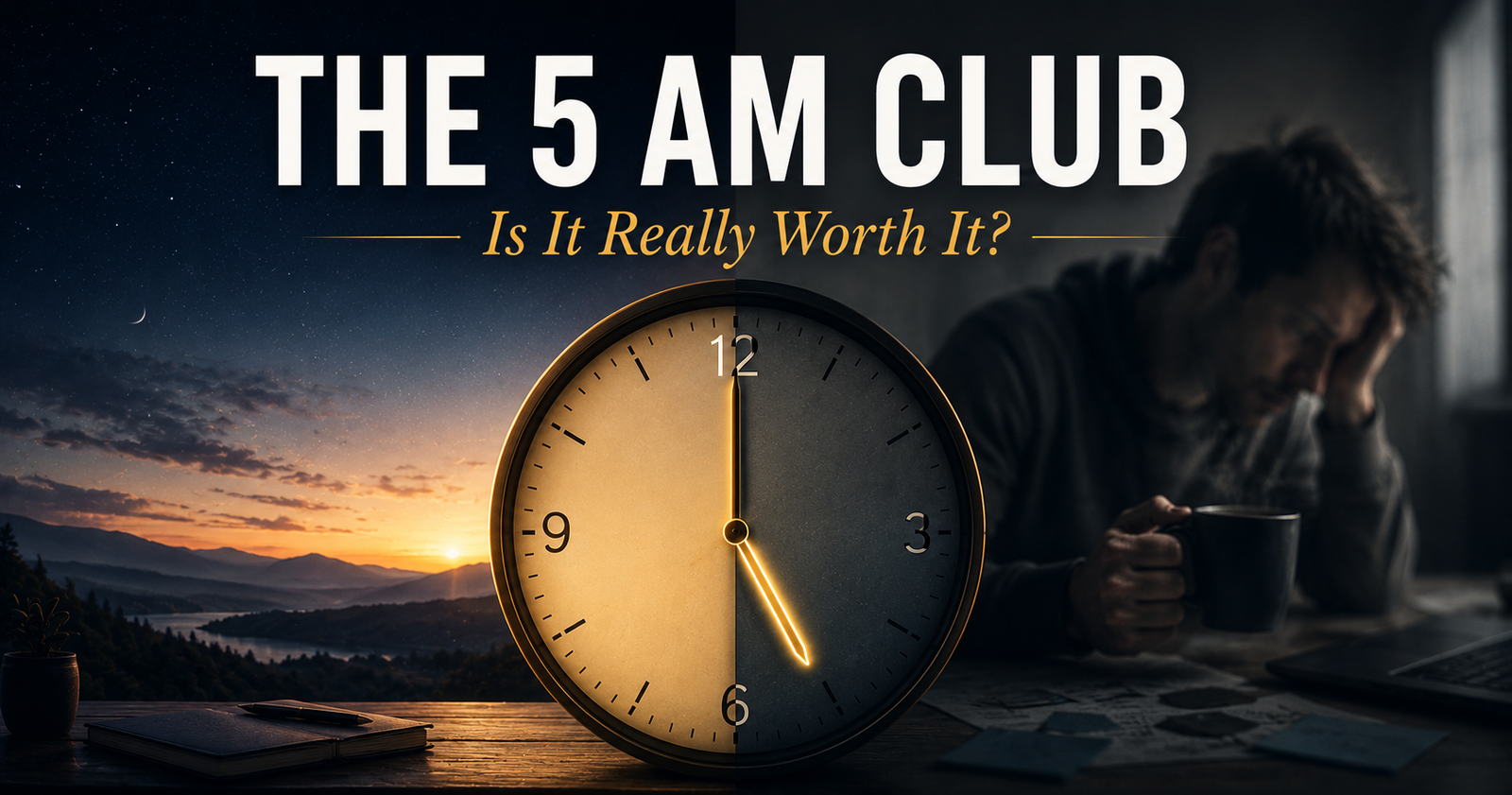
You’ve seen the videos. The ones with dramatic music, an alarm at 4:58 AM, a perfect morning routine, and a confident voice telling you that everyone successful wakes up at 5 AM. Maybe you’ve tried it. Maybe you’ve felt guilty for failing at it. Maybe you’ve convinced yourself that if you could just become a 5 AM person, your life would finally take off.
I’ve watched this movement grow for over a decade. I’ve seen people transform their lives through it. I’ve also seen people destroy their sleep, their health, and their sanity trying to force themselves into a schedule that genuinely didn’t fit them. The truth about the 5 AM club is far more complicated than the motivational videos suggest.
In this article, I’ll cut through the hype and tell you exactly what the research shows, who actually benefits from waking up early, the hidden costs nobody talks about, and how to decide whether the 5 AM club is genuinely worth it for you — or whether you’re just being sold a productivity fantasy.
Where the 5 AM Club Idea Came From
The phrase exploded in popularity after author Robin Sharma published a book titled The 5 AM Club, claiming early waking was the secret habit of world-class achievers. The idea wasn’t new. Historical figures from Benjamin Franklin to Tim Cook to The Rock have publicly promoted early rising. The promise is intuitive — wake before the world, win the day.
But here’s what most early-rising influencers never mention. Many of those same successful people also slept 7-9 hours, which means they went to bed by 9 PM. The 5 AM wake-up wasn’t magic. It was simply the result of a disciplined sleep schedule that allowed enough rest. The 5 AM part gets the credit. The 9 PM bedtime gets ignored. And it’s the second part, not the first, that actually matters.
What the Science Actually Says About Waking Up Early
Here’s where things get interesting — and contradictory. Research on early rising is split, and the truth depends entirely on the individual.
Studies from Harvard Health show some real benefits to morning-oriented schedules — better mood regulation, lower rates of depression in some populations, and improved alignment with natural daylight cycles. Early risers report feeling more in control of their day and often have more consistent routines.
But research published on the American Psychological Association also shows something the morning routine influencers conveniently leave out — chronotypes are partly genetic. Some people are biologically wired to be early birds. Others are biologically wired to be night owls. Forcing a night owl into a 5 AM schedule doesn’t transform them into a high achiever. It produces chronic sleep deprivation, which destroys focus, memory, mood, and immune function.
The science is clear on one point — sleep quantity matters far more than sleep timing. A person sleeping 7-8 hours from 11 PM to 7 AM is healthier than someone sleeping 5 hours from 5 AM workouts to midnight social commitments.
The Real Reason Waking Up Early Sometimes Works
If you’ve successfully joined the 5 AM club and felt your life improve, you’re not imagining it. Something genuine does happen — but it’s not because of the magic of 5 AM. It’s because of several hidden benefits that early rising tends to deliver.
Uninterrupted Time
Before the world wakes up, no one wants anything from you. No emails, no messages, no demands. For people whose days are normally drowned in interruption, the early morning is the only block of focused, undisturbed time they get. The transformation comes from the focus, not the hour.
Identity Reinforcement
Waking up at 5 AM feels disciplined because it is. Every morning you do something hard before most people are awake, you reinforce an identity — “I’m someone who does hard things.” This identity shift bleeds into the rest of your life, making other disciplined choices easier. This is the same psychological principle behind building real self-discipline — identity changes follow consistent action.
Structure and Predictability
Most people don’t actually need 5 AM. They need a consistent morning routine. Whether that’s 5 AM, 6 AM, or 7 AM matters less than the fact that it’s the same time daily. The brain craves rhythm. Erratic schedules destroy productivity far more than late mornings do.
The Hidden Costs of the 5 AM Lifestyle
Now for the part most morning-routine influencers won’t tell you. There are real, serious downsides to forcing yourself into the 5 AM club — especially if your biology, lifestyle, or stage of life doesn’t match it.
Chronic Sleep Deprivation
If you wake at 5 AM but can’t go to sleep before midnight because of work, family, or social commitments, you’re operating on 5 hours of sleep. Research consistently shows this destroys cognitive performance, emotional regulation, and long-term health. You’re not winning your day. You’re slowly damaging your brain. An exhausted morning person performs worse than a well-rested late riser.
Social Isolation
Most of the world doesn’t run on a 5 AM schedule. If you’re in bed at 9 PM every night, you miss dinners, late conversations, social opportunities, and the slow connection moments that often happen after sundown. The early lifestyle can leave you successful but lonely.
Forcing the Wrong Biology
If you’re a genuine night owl, forcing yourself into a 5 AM schedule is like forcing a left-handed person to write with their right hand for the rest of their life. It’s possible. It’s also unnatural, exhausting, and rarely produces the results promised. Many famous “night owls” — including writers, scientists, and artists — produced their best work after midnight precisely because that’s when their biology peaked.
Who Should Actually Join the 5 AM Club?
Based on research and observation, here’s an honest answer about who genuinely benefits from waking up at 5 AM.
People Whose Biology Aligns
If you naturally feel tired by 9 or 10 PM, you’re probably a morning chronotype. For you, the 5 AM lifestyle isn’t a struggle — it’s a fit. You’ll get 7-8 hours of sleep and feel sharp by 6 AM. This group thrives in the early-rising lifestyle.
People Drowning in Daytime Demands
Parents with young kids. Caregivers. People in high-interruption jobs. For these humans, the only quiet time available is before the world wakes up. The early morning offers something the rest of the day never will — solitude.
People Who Genuinely Sleep Early
If you can actually get to bed by 9 or 10 PM, then 5 AM is healthy. If your lifestyle requires you to be active until midnight, 5 AM is self-destruction. This is the test that filters who belongs and who’s just performing.
Who Shouldn’t Be in the 5 AM Club
If you fall into these categories, forcing the 5 AM lifestyle will likely harm you more than help.
Genuine Night Owls
If your peak creativity, focus, or energy happens after 9 PM, your biology has spoken. Fighting it for the rest of your life is a long, slow loss. Embrace your chronotype and design a productive evening routine instead.
Anyone Sleeping Less Than 7 Hours
If joining the 5 AM club means you’ll be sleeping 5-6 hours, don’t join. Your health and performance will suffer far more than any morning routine can recover. Sleep is a foundation, not a luxury.
People in Demanding Evening Roles
Restaurant workers, performers, healthcare professionals on late shifts, parents of newborns — if your life requires late hours, forcing early ones is a guaranteed health crisis. Adapt to your life, not to someone else’s marketing.
What Actually Matters More Than When You Wake Up
After studying productivity and high performers for years, I’ve come to one clear conclusion. The hour you wake up matters far less than the quality of how you live your hours.
A focused, calm, intentional 7 AM riser will outperform a frazzled, exhausted 5 AM riser every single time. A 9 PM bedtime with full sleep produces more clarity than a midnight bedtime with a 5 AM alarm. A consistent routine — at any hour — produces better results than an inconsistent one that just happens to start early.
If you want to optimize your mornings, focus on these things first:
- Get 7-8 hours of sleep consistently, regardless of bedtime
- Build a predictable morning routine you actually look forward to
- Protect the first 30-60 minutes of your day from screens and demands
- Do something meaningful before reactive tasks (email, news, scrolling)
- Align your routine with your natural energy, not with someone else’s
None of these require a 5 AM wake-up. They just require intention. And intention — applied consistently — produces results that the rigid worship of any specific hour never will. This is also why understanding the 1% Rule and how small daily improvements compound matters more than dramatic transformations.
The Truth Behind the 5 AM Movement
Here’s something worth knowing. A lot of the 5 AM content online is sold to you because it’s extreme enough to seem impressive, not because it’s the best advice. Extreme content gets attention. Moderate content gets ignored. Telling people to wake up at 7 AM and be intentional doesn’t make a viral video. Telling them to wake up at 5 AM and dominate the world does — even if the math doesn’t actually work for most people’s lives.
The actual common factor among successful people isn’t the time they wake up. It’s that they’ve designed lives that work for them — and have the self-knowledge to know what works versus what they’re told should work.
Your First Step Toward Better Mornings
Before deciding whether to join the 5 AM club, ask yourself one honest question. What time can I genuinely fall asleep, and what time would I naturally wake up if I had 8 hours of sleep?
That’s your real schedule. Build your morning routine around that, not around what an influencer told you. Maybe it’s 5 AM. Maybe it’s 6 AM. Maybe it’s 7 AM. Whatever it is, commit to it consistently — and use the first hour for something that matters to you, before the world starts pulling at your attention.
You don’t need to be in the 5 AM club to be successful. You need to be in your own club — the one designed for your biology, your life, and your real values. That kind of routine isn’t dramatic enough for social media. But it’s quietly transforming the lives of people who chose intention over imitation.
The most successful people I’ve studied aren’t successful because they wake up at the same time. They’re successful because they’ve stopped performing other people’s routines and started honestly building their own. That option is available to you, starting tomorrow morning — at whatever hour actually works.
What time would your ideal morning routine actually start if you forgot what social media told you? Drop it in the comments — sometimes the honest answer is the beginning of a much healthier life.