
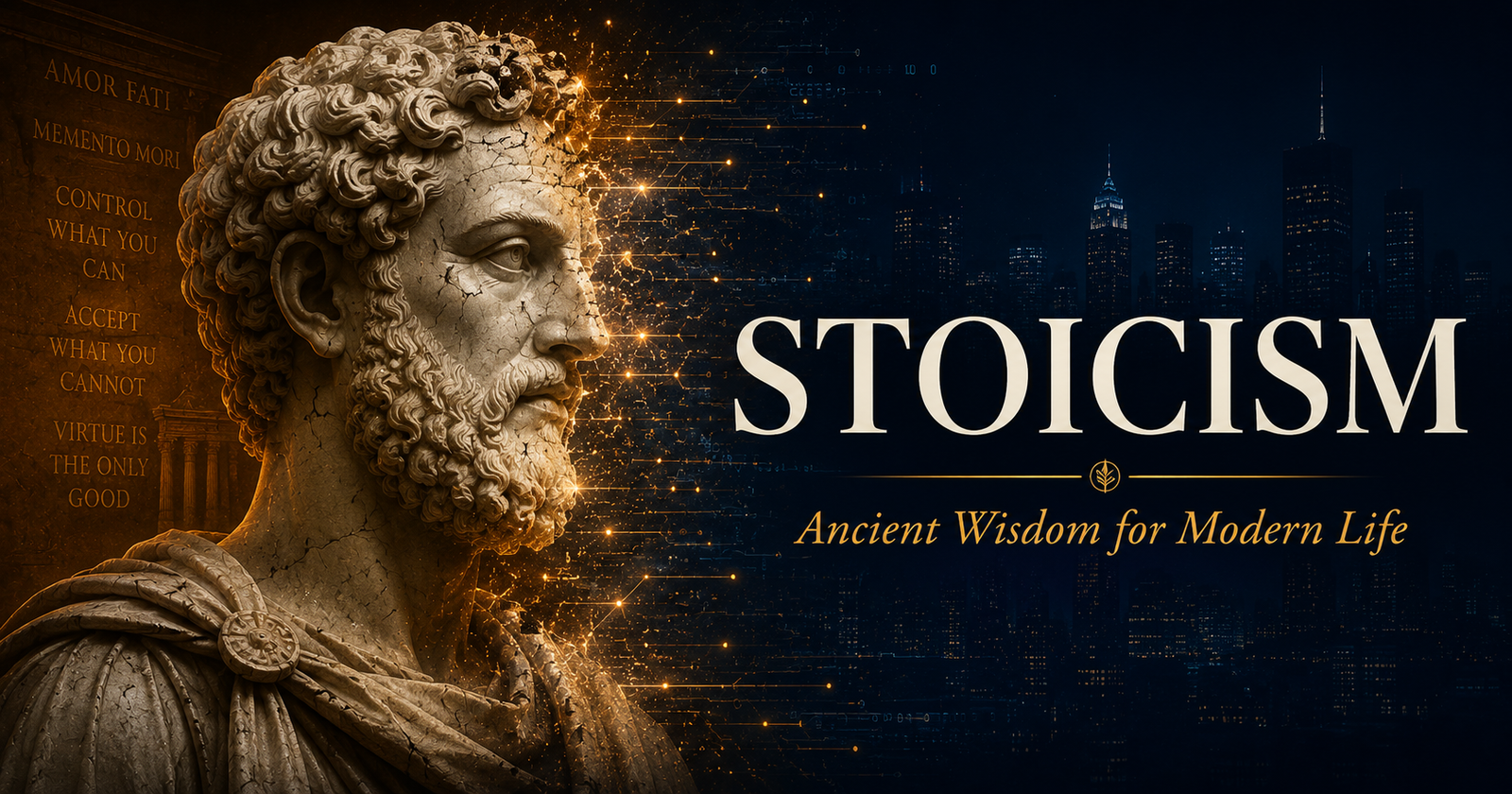
Roughly 2,000 years ago, a Roman emperor sat in his tent at night, writing private notes to himself by candlelight. He was the most powerful man on Earth. He commanded armies, controlled an empire, and could have anything he wanted. Yet most of his journal entries were about controlling something far harder than any empire — his own mind.
His name was Marcus Aurelius. His private notes became one of the most important books ever written: Meditations. And the philosophy he practiced — quietly, daily, for decades — is now being rediscovered by millions of modern people drowning in anxiety, distraction, and chaos.
That philosophy is called stoicism. And after more than a decade studying mindset, behavior, and human psychology, I can tell you this with full confidence — there is no more practical, immediately useful philosophy for modern life. None.
In this article, I’ll walk you through what stoicism actually is (most people get it wrong), the core principles that have helped CEOs, athletes, soldiers, and ordinary people for two millennia, and the simple daily practices you can start using today to think clearer, feel calmer, and live with the kind of inner strength most modern advice can’t even describe.
What Is Stoicism, Really?
Let’s destroy the biggest myth first. Stoicism is not about suppressing your emotions, staying expressionless, or refusing to feel anything. That’s a common misconception fueled by the modern dictionary definition of “stoic,” which has very little to do with actual Stoic philosophy.
Real stoicism is something far more practical and far more powerful. At its core, it’s a philosophy built around one simple idea — you don’t control what happens to you, but you fully control how you respond to it. And in that response lies your entire freedom, dignity, and peace.
Stoicism was founded around 300 BCE by a Greek philosopher named Zeno of Citium. Over the next 500 years, it became one of the most influential schools of thought in the ancient world. Its three most famous practitioners couldn’t have been more different — Marcus Aurelius, a Roman emperor; Epictetus, a former slave; and Seneca, a wealthy advisor and writer. Yet they all reached the same conclusions about how to live well. That’s part of why stoicism endures across centuries — it works regardless of your wealth, status, or circumstances.
Stoicism is a philosophy for actually living, not just thinking. It’s tested. It’s practical. It’s brutal in its honesty. And it has helped more people survive the unsurvivable than almost any other system of thought in human history.
The Single Most Powerful Idea in Stoicism
If you only ever learn one thing from stoicism, learn this — the Dichotomy of Control.
Epictetus, who was born a slave and became one of the greatest philosophers in history, summarized the entire philosophy in a single sentence: “Some things are up to us, and some things are not up to us.”
What’s up to you? Your thoughts. Your actions. Your effort. Your responses. Your character. Your values.
What’s not up to you? Other people’s opinions. The weather. The economy. Whether someone likes you. Whether you get sick. What happened in the past. Death.
Most human suffering comes from this single confusion — we obsess over the things outside our control while neglecting the things inside it. We get furious about traffic, anxious about other people’s opinions, devastated by events that have already happened. Meanwhile, we ignore the only things we can actually shape: our own responses, choices, and effort.
Once you internalize this distinction, the world stops feeling like a place that’s constantly attacking you. It becomes a place full of events you can’t control — and a self that has all the power that actually matters.
The 4 Core Virtues of Stoicism
Ancient Stoics built their entire moral framework around four virtues. These aren’t religious rules or commandments. They’re qualities of character that the Stoics believed produced a deeply meaningful, peaceful life. Every Stoic practice ultimately points back to one or more of these.
1. Wisdom
The ability to see things clearly, without the distortion of emotion, ego, or bias. Wisdom is knowing the difference between what’s real and what your mind is making up. It’s also knowing what’s actually important versus what just feels urgent. This is why understanding cognitive biases that secretly control your decisions is essentially modern Stoic training — it’s about seeing reality clearly.
2. Courage
Not just physical courage in dangerous moments — though that counts. The deeper Stoic courage is the daily kind: facing uncomfortable truths, having hard conversations, doing what’s right when it’s inconvenient, and continuing forward when fear says stop.
3. Justice
Treating others fairly, even when they don’t deserve it. Honoring your responsibilities. Doing right by people who can do nothing for you. The Stoics believed that how you treat the people who have no power over you reveals your real character.
4. Temperance (Self-Discipline)
Moderation. The ability to control your impulses, desires, and reactions. Not punishment — just restraint. Knowing when to stop. Knowing when enough is enough. This is exactly why building real self-discipline is at the heart of every Stoic practice — without temperance, none of the other virtues can survive your impulses.
How Stoicism Changes the Way You See Problems
Here’s what makes stoicism so radically practical — it doesn’t ask you to change the world. It asks you to change how you interpret the world.
Marcus Aurelius once wrote, “You have power over your mind — not outside events. Realize this, and you will find strength.” That single sentence has been quoted by soldiers in war zones, prisoners surviving solitary confinement, parents grieving terrible loss, and entrepreneurs facing complete ruin.
Why? Because it identifies the only place real freedom actually lives — inside you. The world will keep being chaotic. People will keep being unpredictable. Events will keep being unfair. None of that has to determine your inner state. You can lose everything outside and still be wealthy inside — if your inner foundation is solid.
This isn’t toxic positivity. Stoics aren’t pretending pain doesn’t exist. They’re refusing to let pain be the final word. There’s a profound difference between denying suffering and refusing to be destroyed by it. Stoicism teaches the second, not the first.
8 Stoic Practices You Can Start Today
Stoicism isn’t just a set of ideas to admire. It’s a set of practices to perform. The ancient Stoics insisted that philosophy was useless unless it changed how you lived. Here are the most powerful practices, simplified for modern life.
1. The Morning Premeditation
Each morning, before you check your phone or do anything else, spend 60 seconds mentally rehearsing the difficulties you might face that day. Annoying coworkers. Traffic. Bad news. Disappointment. Unfair criticism.
This isn’t pessimism. It’s preparation. By previewing the day’s possible challenges, you take away their power to ambush you. When the difficulty actually arrives, you’re not shocked. You’re ready. Marcus Aurelius opened his most famous passage in Meditations with exactly this practice — and he was running the Roman Empire.
2. The Evening Review
Before sleep, spend 5 minutes reviewing your day honestly. What did you do well? Where did you fall short? What would you do differently? No self-punishment — just observation.
The Stoics believed an unexamined day was a day half-lived. This single habit, performed nightly, accelerates personal growth more than any productivity hack ever invented. You become your own teacher.
3. The Reverse Visualization
Once a day, take 30 seconds to imagine losing something you currently take for granted — your job, your home, your loved ones, your health. Don’t dwell. Just touch the thought briefly.
This sounds dark, but it does something powerful. It transforms ordinary moments into sacred ones. You stop taking things for granted. You start feeling grateful for what’s already in front of you, exactly as it is. Most unhappiness isn’t from lacking things — it’s from failing to see what’s already here.
4. Pause Before Reacting
When something triggers you — an insult, bad news, an annoying message — pause. Just for 5 seconds. Take a breath. Then decide how to respond.
This tiny gap between stimulus and response is, according to Stoics, where all human freedom lives. The reactive person is a prisoner of their emotions. The Stoic is a free human, choosing their response on purpose. Most of the worst decisions of your life were made in the absence of that 5-second pause.
5. Voluntary Discomfort
Regularly do small, uncomfortable things on purpose. Take a cold shower. Skip a meal. Walk instead of driving. Sit in silence without your phone. Sleep on the floor for one night.
This isn’t masochism. It’s training. Research from Harvard Health consistently shows that controlled exposure to discomfort builds psychological resilience. The Stoics knew this 2000 years ago. By voluntarily choosing small hardships, you weaken the grip future hardships have over you. You become harder to shake.
6. Focus Only on What’s Yours to Control
Throughout the day, whenever you notice frustration, ask yourself: Is this thing actually up to me?
If yes, take action. If no, let it go. Worrying about things outside your control is the most popular form of self-torture in modern life — and the most useless. Every minute spent worrying about uncontrollable things is a minute stolen from the things you actually could change.
7. Read One Page of Stoic Wisdom Daily
Get a copy of Meditations by Marcus Aurelius, Letters from a Stoic by Seneca, or the Discourses of Epictetus. Read just one page a day. Not for information. For perspective.
This is the same way the ancients trained their minds — slowly, daily, with reflection. One page builds a different brain than a hundred pages forgotten in a week. This connects deeply to the 1% Rule and how small daily improvements compound into massive results over time.
8. Remember the Final Truth
The Stoics had a Latin phrase — memento mori — “remember you must die.” Sounds morbid. It isn’t. It’s liberating.
When you remember that life is finite, that this day will not repeat, that the people you love won’t be here forever — petty grievances dissolve. Small worries shrink. You stop wasting your one life on what doesn’t matter. You start showing up fully to what does. Death isn’t the enemy of life. It’s the reason life matters.
Why Stoicism Is Quietly Exploding in the Modern World
Stoicism is having a massive resurgence, and it’s not random. Modern life produces uniquely modern problems that no other philosophy seems equipped to handle — endless distraction, constant comparison, information overload, social media anxiety, eroding attention, manufactured outrage, the death of meaning.
Stoicism cuts through all of it. It doesn’t ask you to retreat from the world. It doesn’t require religion. It doesn’t demand belief. It just gives you tools — simple, brutal, deeply effective tools — for navigating a chaotic existence with grace.
That’s why CEOs read it. Athletes read it. Soldiers read it. Therapists secretly base half their advice on it (Cognitive Behavioral Therapy is essentially Stoicism in a lab coat). It works because human nature hasn’t changed in 2000 years — and neither has the wisdom that responds to it.
Common Misconceptions About Stoicism
Before you go deeper, let me clear up three common misunderstandings that keep people from really benefiting from stoicism.
It’s Not About Suppressing Emotions
Stoics weren’t robots. They felt grief, joy, anger, love — fully. The difference is they didn’t let these emotions hijack their judgment or destroy their inner peace. They felt deeply and acted wisely. Those aren’t opposites.
It’s Not About Passivity
Some people think Stoicism teaches you to “accept everything.” It doesn’t. The Stoics were generals, statesmen, writers, and leaders. They acted decisively in the world. The acceptance is internal, not external. You accept reality clearly, then act on it powerfully. Big difference.
It’s Not About Being Cold or Detached
Marcus Aurelius wrote tenderly about his teachers. Seneca wrote loving letters to friends. The Stoics were deeply human. The myth that they were cold and emotionless says more about modern misunderstanding than about the philosophy itself.
Your First Step Into Stoic Life
You don’t need to become a philosopher overnight. You don’t need to read everything. You don’t need to wear a toga. You just need to start practicing — one tiny habit, one ordinary day at a time.
Pick one practice from this article. Just one. The simplest one — maybe the 5-second pause before reacting, or the morning premeditation, or one page of Meditations a day. Do it for 30 days. Don’t tell anyone. Don’t perform it for show. Just live it quietly.
You’ll be surprised what starts happening. Small frustrations stop running your day. People who used to upset you barely register. The chaos of modern life still happens around you, but it stops happening to you. You become someone with a stronger center than the world has noise.
That’s what stoicism really is — not a system of beliefs to debate, but a quiet practice of becoming harder to break. The world keeps trying to disturb your peace. The Stoic just stops cooperating with it.
Two thousand years ago, an emperor wrote private notes to himself trying to figure out how to live well in an unpredictable world. We’re still reading those notes because the world is still unpredictable — and human nature is still confused. The wisdom hasn’t aged because the problems haven’t changed. Only the costumes have.
The same questions Marcus Aurelius wrestled with in his tent are the questions you wrestle with in your bed at night. The good news? The answers haven’t gone anywhere. They’ve been waiting, patient as marble, for you to come find them.
And now, you have.
What’s one Stoic practice you’re going to try this week? Drop it in the comments — sometimes saying it out loud is the first step to actually living it.